Overview
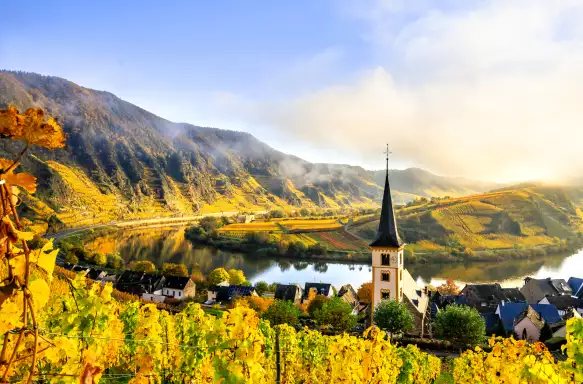
Four days in the Mosel valley, based in Bernkastel-Kues — Germany's prettiest wine town — on the stretch of river where the vineyards are steepest and the villages closest together. There is a wine festival somewhere on the Mosel almost every weekend from June to October, so the question is less whether one is on than which one you land next to.
For an inexperienced cyclist this is arguably the best destination in Europe: the Mosel Cycle Path is flat, asphalted, car-free and impossible to get lost on — it follows the river. The RegioRadler cycle bus (bikes on a trailer) and local trains are the safety net, so no ride ever has to be ridden twice. And it is comfortably one of the cheapest trips on the list.
Getting There
| Outbound | Ryanair, Stansted → Frankfurt-Hahn (HHN), ~1h20, typically £30–60 one way |
| Return | Ryanair, Hahn → Stansted, typically £30–60 one way |
| Hahn → Bernkastel | Pre-booked taxi, ~35 min over the Hunsrück, €60–70 total (~€22 each) |
| Fallback route | easyJet Gatwick–Luxembourg, then bus/train via Trier (~2.5h ground). Works, but Hahn is far quicker |
Day by Day
Friday Arrive & warm-up loop
- Morning Ryanair, taxi over the hills — in Bernkastel by early afternoon. Shortest door-to-door of any trip.
- Collect bikes; warm-up loop over the bridge to Wehlen and Zeltingen past the Sonnenuhr vineyards, back along the far bank — ~15km, pancake flat.
- Tasting at S.A. Prüm in Wehlen on the way round (book ahead).
- Evening: the medieval Marktplatz — dinner at Doctor Weinstuben, glass of Bernkasteler Doctor from the cliff above the roof.
Saturday Down the river to the station, the train to Bullay, home over the ridge
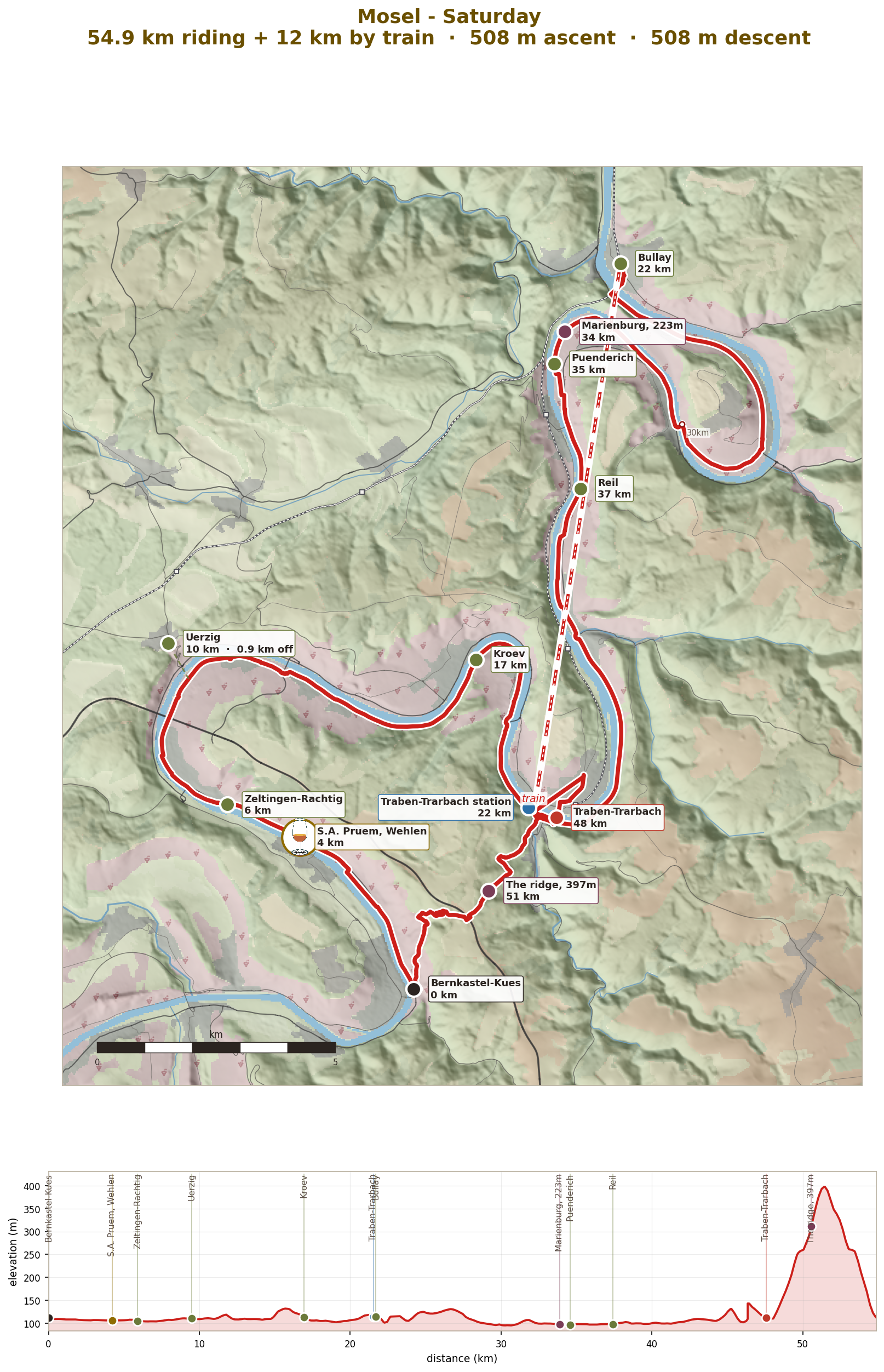
- 54.9km with 508m of ascent, plus a 12km train in the middle. Flat for the first forty-seven kilometres, and then one climb.
- Downstream along the water from the first turn of the pedals, on the bank the cycle path actually uses. S.A. Prüm at Wehlen at 4km, opposite the Wehlener Sonnenuhr — the sundial built into the slope in 1842 so the pickers could tell the time, and Riesling from one of the great sites on the river. It is early in the day for a tasting and it is only 4km from the hotel, so it may sit better as a separate evening spin than squeezed into the morning.
- Zeltingen-Rachtig at 6km, then Ürzig at 10km where the slate turns red and the vineyards go vertical, and Kröv at 17km — home of the Kröver Nacktarsch label, which is exactly what it looks like.
- Traben-Trarbach station at 22km. The RB85 Moselweinbahn runs up the branch to Bullay in twenty minutes, roughly hourly. Bikes travel, but a two-car railcar has finite space and there is no reservation, so a quieter departure is worth aiming for.
- Bullay at 22km on the clock and no distance ridden. Off the train and straight back onto the water. Everything from here is upstream and level.
- The long way round the Zeller Hamm — the tightest meander on the Mosel, where the river takes twenty kilometres to travel two — with the Marienburg at 34km and 223m on the neck of it, then Pünderich at 35km and Reil at 37km.
- Traben-Trarbach again at 48km, this time at river level and in the afternoon: a wine town rebuilt almost entirely in Jugendstil after the fire of 1857, which is why it looks like nowhere else on the river. Lunch here, before the climb.
- Then the ridge. The last 8km cut over the hill rather than following the river round — up to 397m, 292m of climbing, and all the difficulty of the day in the final stretch. The flat alternative is to stay on the water and retrace the morning’s road: 22km instead of 8, level the whole way, and it makes the day 68km with 247m of climbing.
- The Calmont is not on this route. It sits four kilometres downstream of Bullay: the steepest vineyard in Europe at around sixty-five per cent, worked with winches and via ferrata cables. If you want it, ride out and back from Bullay before turning upstream — about 10km, flat. You do not ride the Calmont itself. You stand at the bottom and look up at people doing something that ought not to be legal.
Sunday RadBus to Roman Trier, then the whole river home
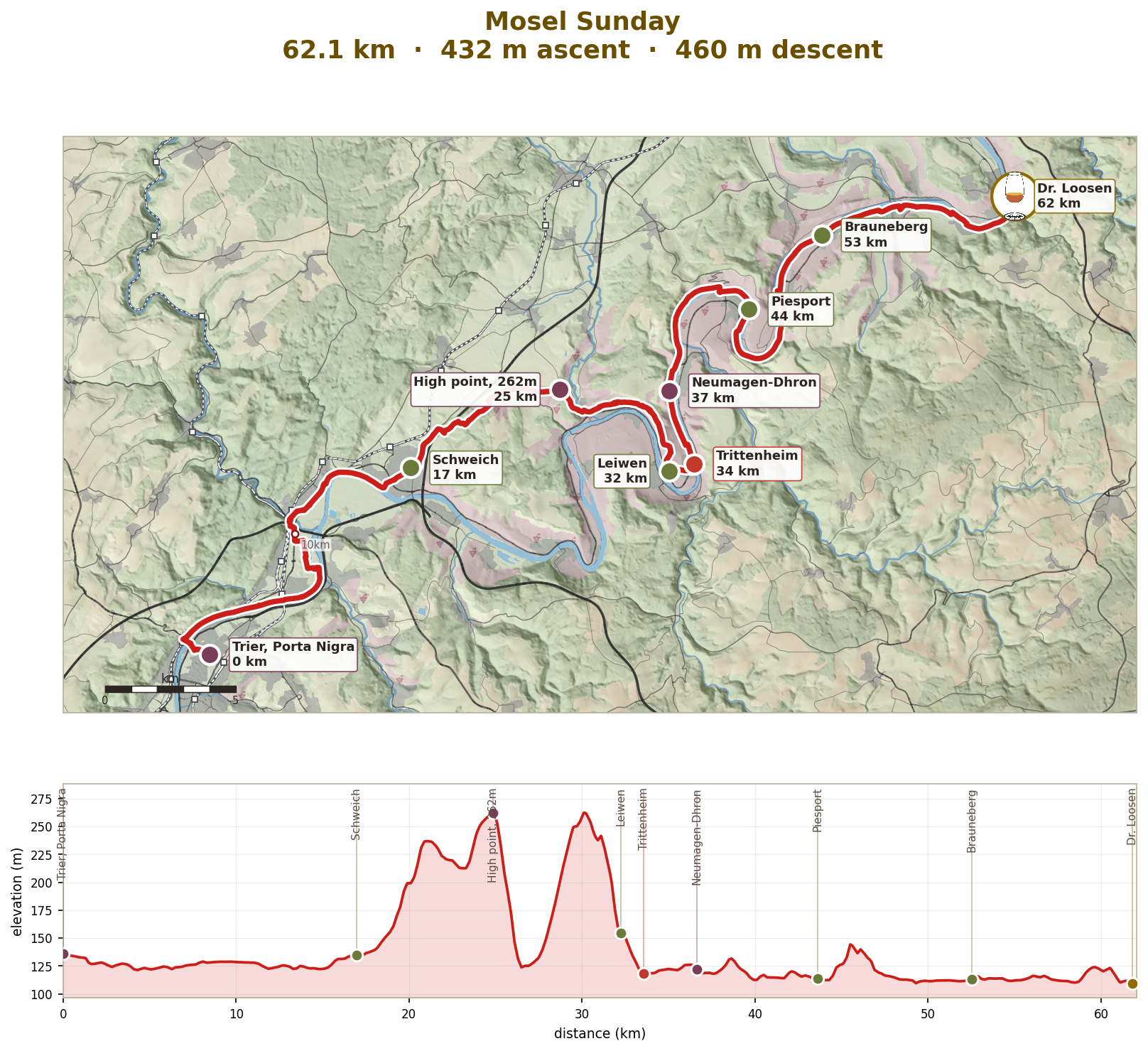
- 62.1km with 432m of ascent, and the best day of the weekend — bus up, ride back, finishing at the front door.
- Take the RadBus Moseltal (line 333) to Trier, which runs Saturdays, Sundays and public holidays, plus weekdays in Rhineland-Palatinate school holidays. Bikes are €3. Start at the Porta Nigra: the largest Roman city gate north of the Alps, black with two thousand years of weather, in a city that has three separate UNESCO Roman monuments and was an imperial capital.
- Out through Schweich at 17km, then the route leaves the towpath and climbs the shoulder to 262m at 25km — the only real effort of the day, and the reason the total is 432m rather than nothing.
- Trittenheim at 34km is lunch, in the first of the great river loops.
- Neumagen-Dhron at 37km is the oldest wine town in Germany — the Romans left an inscription saying so, and a third-century stone relief of a galley carrying wine barrels, the Weinschiff, which is the reason every Mosel wine label with a boat on it has a boat on it.
- Piesport at 44km, Goldtröpfchen rising behind it in a natural amphitheatre, then Brauneberg at 53km and the Juffer-Sonnenuhr — the site Napoleon is supposed to have rated above every other on the river.
- Dr. Loosen at 62km, which is to say at the end: ungrafted old vines in Wehlener Sonnenuhr, Ürziger Würzgarten and Erdener Prälat, bone-dry GG through to honeyed auslese. Five wines €15, seven €25, book two or three weeks ahead. Walkable from the hotel, which is exactly where the day's tasting belongs.
Monday Castle & home
- Morning walk up to Burg Landshut, the ruined castle above town — 30 minutes up, the whole river bend below.
- Return bikes, last riesling for the suitcase; taxi to Hahn for the Ryanair home. (If the day's single flight leaves early, the castle moves to Sunday.)
Festivals & Local Events
None of this weekend assumes a festival. The rides work on any weekend of the season. Between June and September there is a Weinfest in one village or another most weekends, and the useful trick is to find out which and end that day’s ride there rather than at the base — the train comes back up the valley in the evening. If it is Happy Mosel in June the main road is closed to cars and that is the ride, whatever was planned. The trade is worth stating plainly: on a festival weekend the growers are behind a stand in the square rather than showing visitors round a cellar, so book private tastings weeks ahead or accept that some will be shut, and expect beds to be scarcer, dearer and gone months in advance.
Spring
Happy Mosel — June
The main valley road is closed to traffic for a day and given over to cyclists and walkers, from Schweich up to Cochem. Tens of thousands ride it, and it is glorious.
Summer
Weinfeste in every village — June to September
Bernkastel, Zell, Traben-Trarbach, Piesport and a dozen more each hold their own. Trestle tables, a brass band, and the growers pouring their own.
Autumn
Bernkastel Weinfest der Mittelmosel — early September
The largest on the river: a week of tastings, fireworks over the water and a wine queen.
Federweißenfest, Zell — October
Cloudy, half-fermented new wine with onion tart on the market square. Unpretentious, and reached by riding the prettiest stretch of the valley.
The Region in Brief
A little history
Germany’s oldest wine region: the Romans planted these slopes from Trier (Augusta Treverorum, Germany’s oldest city), and Ausonius was praising the vineyard views in verse by 371 AD. Medieval church estates built the great sites — the Bernkasteler Doctor cliff is named for the wine said to have cured a 14th-century prince-elector — and by 1900 Mosel riesling fetched higher prices than first-growth Bordeaux. It remains home to the steepest vineyards on earth.
Spring — March to May
7–18°C. The river path is empty, the slate slopes are bare, and the villages have their pavements back. Chilly in the mornings, and rain is common — but the valley greens up dramatically through May.
Summer — June to August
16–26°C. The valley traps heat, so the steep slopes get properly warm; the river is swimmable if you are brave and careful about boat traffic. Weinfest season starts, and every village has one.
Autumn — September and October
9–18°C. Golden vines above a grey-green river, Federweißer in the taverns, and the best photographs of the year. September is warm and settled more often than not; October is cooler and mistier.
When to go
Early September. Warm, dry more often than not, with the village wine festivals running and the harvest about to start.
The wines
Riesling on blue and red slate, in every register: featherweight kabinett, taut dry Grosses Gewächs, honeyed auslese — plus Elbling (Germany’s oldest grape) on the upper river, and in October, Federweißer: the cloudy, half-fermented new wine the festival exists for.
The food
Zwiebelkuchen (onion tart, the mandatory Federweißer pairing), zander from the river, riesling cream soup, hearty weinstube pork cooking, and Winzersekt — grower sparkling riesling — for the last night.
Where to Stay
Doctor Weinstuben (4★)
A minute from the Marktplatz with a proper wine restaurant downstairs. First choice.
Moselhotel Sonnenuhr (3★)
Faces the river on the Kues side, with bike and e-bike hire in-house — logistics made trivial.
Hotel Zur Post (3★ sup.)
Traditional, comfortable, good breakfast for cycling mornings.
The Wineries
Dr. Loosen
Wehlener Sonnenuhr, Ürziger Würzgarten and Erdener Prälat from ungrafted old vines, bone-dry GG to honeyed auslese. Walkable from the hotel. Tastings by appointment: 5 wines €15, 7 wines €25 — book 2–3 weeks ahead.
S.A. Prüm
Cellar-door tastings across the sundial vineyards. (The legendary J.J. Prüm next door doesn't receive visitors — order their wine at dinner instead.)
Markus Molitor
The perfectionist of the modern Mosel: 120+ parcels, bone-dry to nobly sweet. On the Friday route; visits by arrangement.
Eat & Drink
| Friday | Doctor Weinstuben — Mosel classics and a deep local list |
| Saturday | Lunch in Traben-Trarbach; dinner in Bernkastel — Brauhaus for something plain, or Zwiebelkuchen and a glass of whatever is being poured if a village fest is running |
| Sunday | Winzer tavern in Piesport; dinner anno 1640 (book) |
| Monday | Breakfast, castle, home |
Useful Links
- Zeller Land tourism — Federweißenfest — official tourism site for Zell, festival details each autumn
- Weinland Mosel — the official Mosel wine board — growers, festivals, the region
- The Mosel Cycle Path — official route guide — stages, maps, bike-friendly hosts
Practical Notes
- Bernkastel has no railway station — the old Moselbahn is long gone, and Wittlich Hauptbahnhof is about 12km away. That is why the bike buses matter here more than anywhere else on the list.
- Two bike-bus lines serve the town. RadBus Moseltal (333) runs Trier–Bernkastel via Neumagen on Saturdays, Sundays and public holidays, plus weekdays in Rhineland-Palatinate school holidays — that is the one the Sunday depends on. RegioRadler MaareMosel (300) runs Bernkastel–Wittlich–Daun daily, roughly two-hourly from 7am to 8pm, with a 22-bike trailer. Bikes are €3.
- The Saturday needs one train, in the middle. RB85 Traben-Trarbach to Bullay, twenty minutes, roughly hourly, and the day ends back at the hotel under your own steam — so there is no lift to arrange and nothing to settle in advance. Check the bike allowance on the branch before you set off; the RegioRadler cycle bus does not go downstream past Traben-Trarbach.
- Germany is the outlier: 1.6‰ before a cyclist is automatically unfit, but 0.3‰ is enough to be prosecuted if you ride badly or come off. A conviction on a bicycle can cost you your car licence. See the country-by-country table.
- Flights first: one Ryanair a day each way — confirm the days and times for your dates before booking anything else, and build the weekend around them.
- GuestTicket: free with any overnight stay — free local buses and trains, bikes carried free on weekends. Ask at check-in.
- Book ahead: Dr. Loosen and S.A. Prüm, hotel, Saturday-evening return from Zell (RegioRadler or van taxi), anno 1640.
- Bikes: 10+ hire stations in town, €15–20/day touring bike, €30–40 e-bike (optional — it's flat). Hire all three days.
- Weather: see the three-season table below — the valley runs from 7–18°C in spring to 16–26°C in high summer. It traps heat, so the slopes get warmer than the forecast suggests, and the river throws up morning mist in the cooler months. Layers and a light waterproof whenever you go.
- Currency: euros. Carry cash — village festival stands and the smaller winzer taverns often take nothing else.