Overview
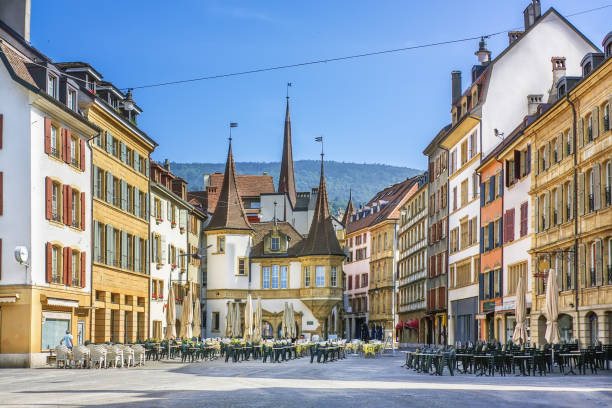
Four days on Lake Neuchâtel, the wild-card option: Switzerland's largest fully-Swiss lake, a medieval sandstone old town, and a ribbon of vineyards between the Jura and the water producing Chasselas, Pinot Noir and the salmon-pink Œil de Perdrix. If your dates fall in early October there is also the Fête de la Vendange at Cortaillod — a proper village harvest festival, guggenmusik bands, growers' stands, a procession through the old lanes, and barely a tourist in sight — but the weekend does not depend on it.
The cycling suits a beginner perfectly: Swiss national Route 5 runs along the lakeshore on segregated paths with, as the Swiss put it, “no ups or downs worth mentioning”, and the vineyard villages sit in a neat line ten minutes apart. Switzerland's absurdly good trains (and the little Littorail tram) bring you home — no panniers. The trade-off is the wallet.
Getting There
| Outbound | easyJet, Gatwick → Geneva (GVA), morning, from ~£30–60 one way (~20 flights/day on the route) |
| Return | easyJet, Geneva → Gatwick, evening, from ~£40–70 one way |
| Onward train | Geneva Airport → Neuchâtel: station inside the terminal, direct trains roughly hourly, ~1h15, from ~CHF 30 (cheaper as advance "supersaver" fares on sbb.ch) |
Day by Day
Friday Arrive & the old town
- Morning easyJet; direct train from the airport station into Neuchâtel mid-afternoon. Check in.
- Explore the old town: the château, the collegiate church, sandstone Dumas said was "carved out of butter".
- Early dinner in the old town. In festival week, take the Littorail tram from Place Pury out to Cortaillod for the opening night of the Fête (from 18:00) — stands, cliques, guggenmusik, the village up until 3am, and no obligation whatever to match it.
Saturday Train to La Neuveville, the wine route down the lake, boat home
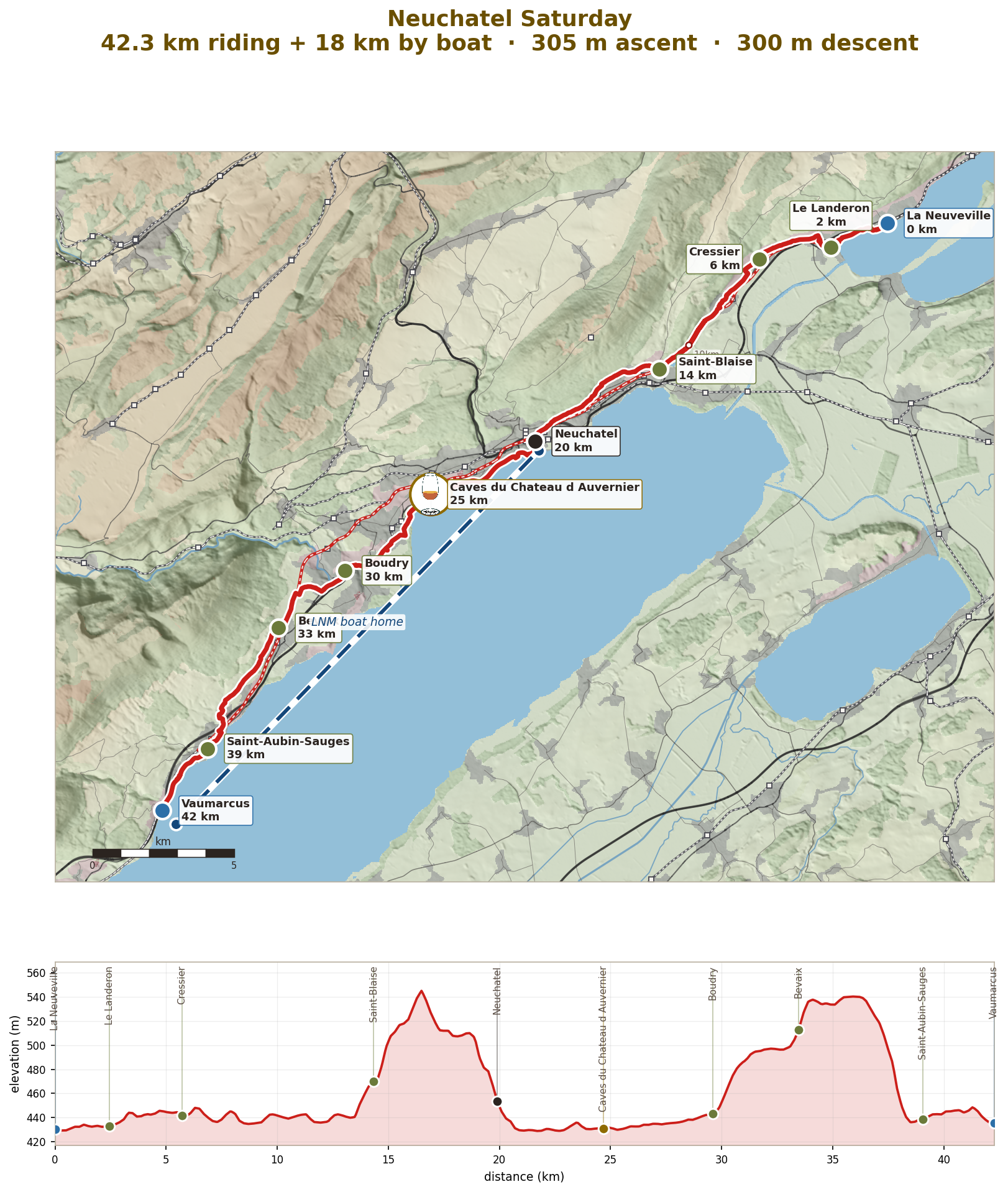
- 42.3km with 305m of ascent, plus an 18km boat home — the canton’s own Route du Vignoble, ridden from the far end so the wine is the whole day rather than the last few kilometres of it.
- Train out to La Neuveville first thing, about twenty-five minutes. A walled medieval town at the eastern end of the vineyard, and the start of the wine route.
- Le Landeron at 3km — the old town is a single long tree-lined square, and one of the prettiest in Switzerland — then Cressier at 6km, the first of the wine villages proper.
- A short pull away from the shore and back down to Saint-Blaise at 15km, where the vineyard comes down to the lake.
- Neuchâtel at 20km, and exactly half way: the route runs straight past your own hotel. The obvious place to stop if the weather has turned, and a hard place to ride past if it has not.
- Caves du Château d’Auvernier at 25km — the largest cellar in the canton, in a 16th-century château on the water, and the easiest tasting on the route to walk into. Chasselas and Pinot Noir, and the Oeil-de-Perdrix rosé that Neuchâtel invented.
- Boudry at 30km at the mouth of the Areuse gorge, then the second small climb and down to Bevaix at 34km. The Pointe du Grain below the village is the picture everyone takes of this vineyard.
- Saint-Aubin-Sauges at 39km, the last of the wine villages, and Vaumarcus at 42km — the western end of the Neuchâtel vineyard, and the landing stage.
- The boat home. LNM run back up the lake to Neuchâtel, about an hour. Seasonal, so check the timetable before you commit to it — and note the train from Gorgier-Saint-Aubin, a couple of kilometres back, as the fallback.
Sunday Round the top of the lake, down the wild shore, boat home
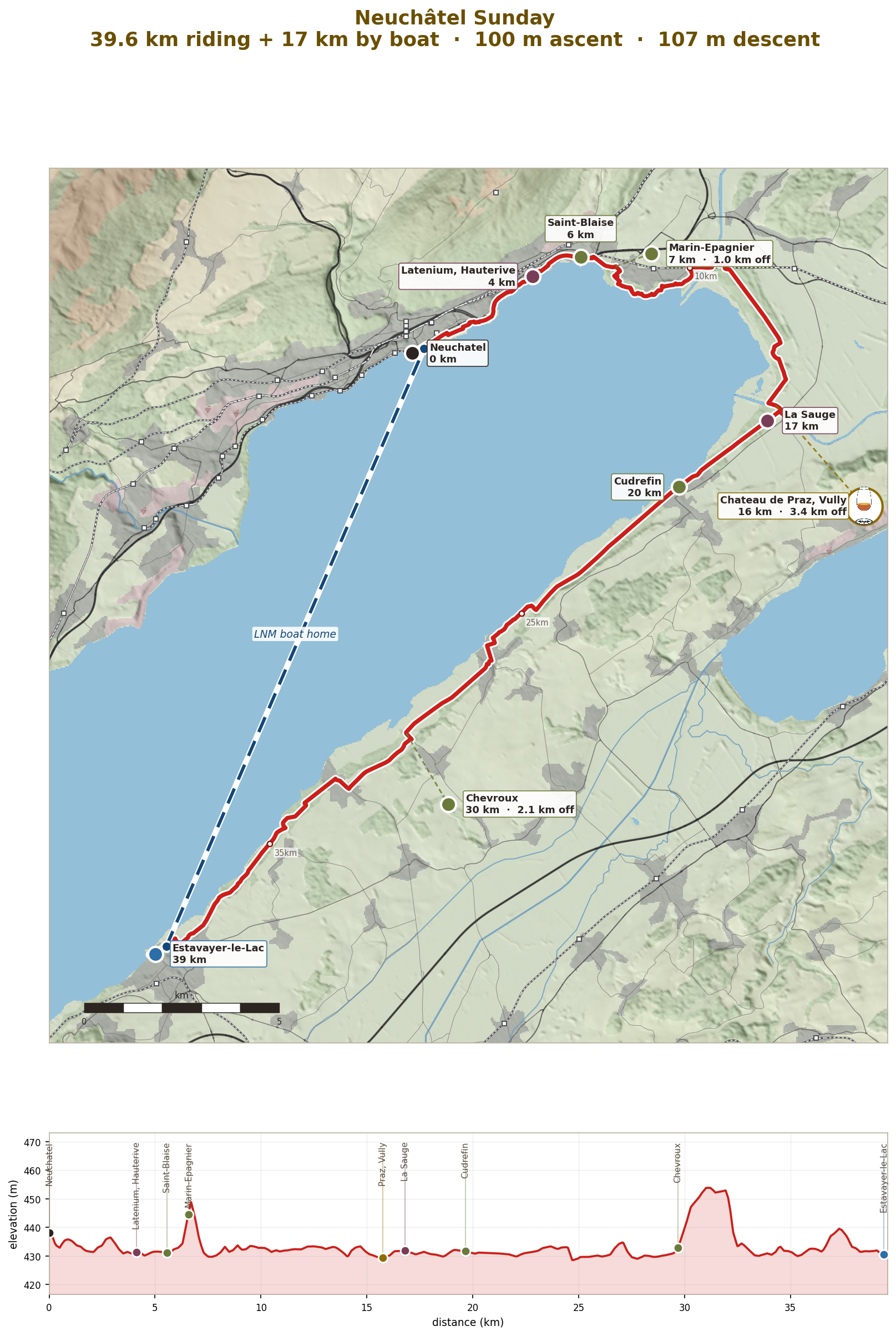
- 39.6km with 100m of ascent — as flat as riding gets, and a complete contrast to the Saturday.
- The Laténium at Hauterive, 4km out, is the stop to make time for: Switzerland's largest archaeology museum, built over the lakeside pile-dwelling site that gave the La Tène Iron Age its name — the period is called after this stretch of water.
- Through Saint-Blaise and Marin, then onto the Broye canal, the cut that links Lake Neuchâtel to Lake Murten, and round the top of the lake to Cudrefin at 20km.
- La Sauge on the way marks the edge of the Grande Cariçaie — the largest lakeside marsh in Switzerland, thirty kilometres of reed bed and wet meadow along the south shore, and a reserve of national importance. This side has almost no road on it, which is the point.
- South-west through Chevroux to Estavayer-le-Lac at 39km, a walled medieval town with a castle on the water.
- Boat home. LNM run Estavayer to Neuchâtel across the lake, taking bikes for 5 francs one stop or 8 for a day pass. The season runs daily from mid-June to late September, and Fridays to Sundays plus holidays from mid-April and again in October — outside that the train from Estavayer does the job instead.
Monday Home
- Slow morning: lakefront coffee, the market square, absinthe shopping — the Val-de-Travers behind Neuchâtel is the birthplace of absinthe, and a small bottle travels well.
- Afternoon train along the lake to Geneva airport; evening flight home.
Festivals & Local Events
None of this weekend assumes a festival. The rides work on any weekend of the season. If your dates land on Cortaillod’s Fête de la Vendange in early October, the Saturday route runs through the village — time the ride to arrive there in the afternoon and take the train home. The trade is worth stating plainly: on a festival weekend the growers are behind a stand in the square rather than showing visitors round a cellar, so book private tastings weeks ahead or accept that some will be shut, and expect beds to be scarcer, dearer and gone months in advance.
Spring
Absinthe country opens up — Val-de-Travers
The distilleries behind Neuchâtel run tours through the warmer months; the valley is where absinthe was invented and where it was illegally distilled for a century.
Summer
Festivals on the quays
Neuchâtel fills its lakefront with music and open-air cinema through July and August, and the beaches at Saint-Aubin and Cortaillod come into their own.
Autumn
Fête des Vendanges, Neuchâtel — late September
The region's giant harvest festival: a corso fleuri parade, guggenmusik bands and a town given over to wine for three days.
Fête de la Vendange, Cortaillod — early October
The village version a week or two later, and the better one — growers' stands in the old lanes, cliques doing the rounds, and barely a tourist in sight.
The Region in Brief
A little history
Novum Castellum was first recorded in 1011, and vines on this shore appear in charters from 998 AD. The lakeside at La Tène yielded so many Celtic artefacts that it named an entire era of European prehistory; the town itself spent a surreal century as a Prussian principality inside the Swiss Confederation (until 1848); watchmaking built its fortunes; and the Val-de-Travers behind the vineyards invented absinthe.
Spring — March to May
8–17°C, sharp and clear, with snow still on the Alps across the water — the best visibility of the year. The lakeside path is empty. Too cold to swim unless you are committed.
Summer — June to August
16–25°C, and the lake climbs to 20–22°C, which makes it a genuinely good swimming lake. Long evenings on the quays, and the vineyard belt is green rather than gold.
Autumn — September and October
10–18°C, the vines turning copper along the shore, and the bise wind giving knife-sharp views over to the Alps. Harvest festivals through late September and early October.
When to go
Early September. The lake is still swimmable at around 19°C, the harvest is starting, and the light is at its clearest.
The wines
A tiny 600-hectare appellation that Switzerland drinks almost entirely itself: Chasselas as the crisp everyday white, serious Pinot Noir (Cortaillod is its best terroir), Œil de Perdrix — the salmon-pink Pinot rosé invented here — and the January curiosity of Non Filtré, cloudy unfiltered Chasselas.
The food
Fondue moitié-moitié (Gruyère and Vacherin Fribourgeois, taken seriously), lake perch and féra, saucisson neuchâtelois IGP, taillaule brioche, raclette at the festival stands — and a cautious absinthe to finish.
Where to Stay
Beau-Rivage (5★)
Alps across the water from the breakfast table. Expensive — but if you are paying for the priciest destination on the list, you may as well see the view.
Hôtel des Arts (3★ sup.)
Well-run, contemporary, a short walk from old town and station. The value pick — and in Switzerland that word earns its keep.
Hôtel Alpes et Lac (3★ sup.)
Handy for the Geneva trains, lake-and-Alps views from the front rooms.
The Wine
Neuchâtel is one of Switzerland's oldest appellations: Chasselas as the everyday white, serious Pinot Noir, and Œil de Perdrix — the pale “partridge eye” rosé invented here. Almost none of it leaves Switzerland, which is the point: a wine region you can only really drink in situ.
Caves du Château d'Auvernier
The benchmark estate of the lake, in the château cellars at the top of Auvernier's single, absurdly pretty street. Visits and tastings by prior arrangement; shop keeps Saturday-morning hours. Book a week or two ahead.
Caveau de dégustation de Boudry
A medieval tower in the vines where Boudry growers take turns pouring at cellar-door prices. Open weekend afternoons in season — confirm hours locally.
Domaine de la Maison Carrée
The traditionalist counterpoint to the château for a second Auvernier tasting. By appointment.
Eat & Drink
| Friday | Early plate in Neuchâtel — or the Cortaillod festival stands in festival week (raclette, grilled sausage, new vintage) |
| Saturday | Festival stands at lunch; fondue moitié-moitié in the old town at night (book — they're small) |
| Sunday | Lakeside picnic; dinner Brasserie Le Cardinal — tiled art nouveau room, lake perch, Chasselas by the carafe |
| Monday | Lakefront coffee, market, home |
Useful Links
- Fête de la Vendange, Cortaillod — official Jura & Three-Lakes tourism listing
- Neuchâtel Vins et Terroir — the official wine and produce body — winemakers, caveaux, events
- SchweizMobil — Route 5 (Mittelland) — official Swiss cycling network page for the lakeshore route
Practical Notes
- Switzerland is the strictest country here for bikes on trains. You need a bike ticket or a Velo-Tageskarte on top of your own fare, and on the InterCity services through Neuchâtel a bicycle reservation is compulsory from 21 March to 31 October. Book it when you book the beds, not on the platform.
- The Sunday boat is seasonal. LNM run daily from mid-June to late September, and Fridays to Sundays plus public holidays from mid-April and through the first half of October. Bikes are 5 francs for a single hop or 8 for the day. Outside the season, take the train back from Estavayer.
- The two days are near enough twins. Saturday is 42km down the vineyard with 305m of climbing; Sunday is 40km round the far shore with 100m. Neither is hard, and both end on a boat rather than a climb — which is the whole design of the weekend.
- Ride the wine route east to west, not west to east. Same road either way, but starting at La Neuveville puts Auvernier at 25km of 42 and the boat at the end. The other direction ends with a train and puts the cellar door in the first half-hour.
- Switzerland allows cyclists 0.5‰; at that level you are deemed unfit to ride and there is no arguing the point. See the country-by-country table.
- Budget honestly: Switzerland is roughly double Germany — mains CHF 25–40, beers CHF 7. Flights and bikes are normal money; everything with a waiter is not.
- Bikes: Location Vélo Neuchâtel or Bcyclet deliver to the hotel from ~CHF 20–25/day; Neuchâtelroule by the port for cheap city bikes. Book Saturday delivery.
- Bikes on trains: CHF 14 day pass, buy in the SBB app. Littorail tram covers festival nights without bikes.
- Book ahead: hotel, Château d'Auvernier, bike delivery, fondue table. Swiss train fares drop a lot as advance "supersavers" on sbb.ch.
- Currency: Swiss francs. Cards accepted absolutely everywhere.
- Weather: 8–17°C in spring with the best visibility of the year, 16–25°C in summer, 10–18°C in autumn with the bise giving knife-sharp views to the Alps. The lake reaches 20–22°C in summer, which is the only season the swim is a pleasure rather than a dare.