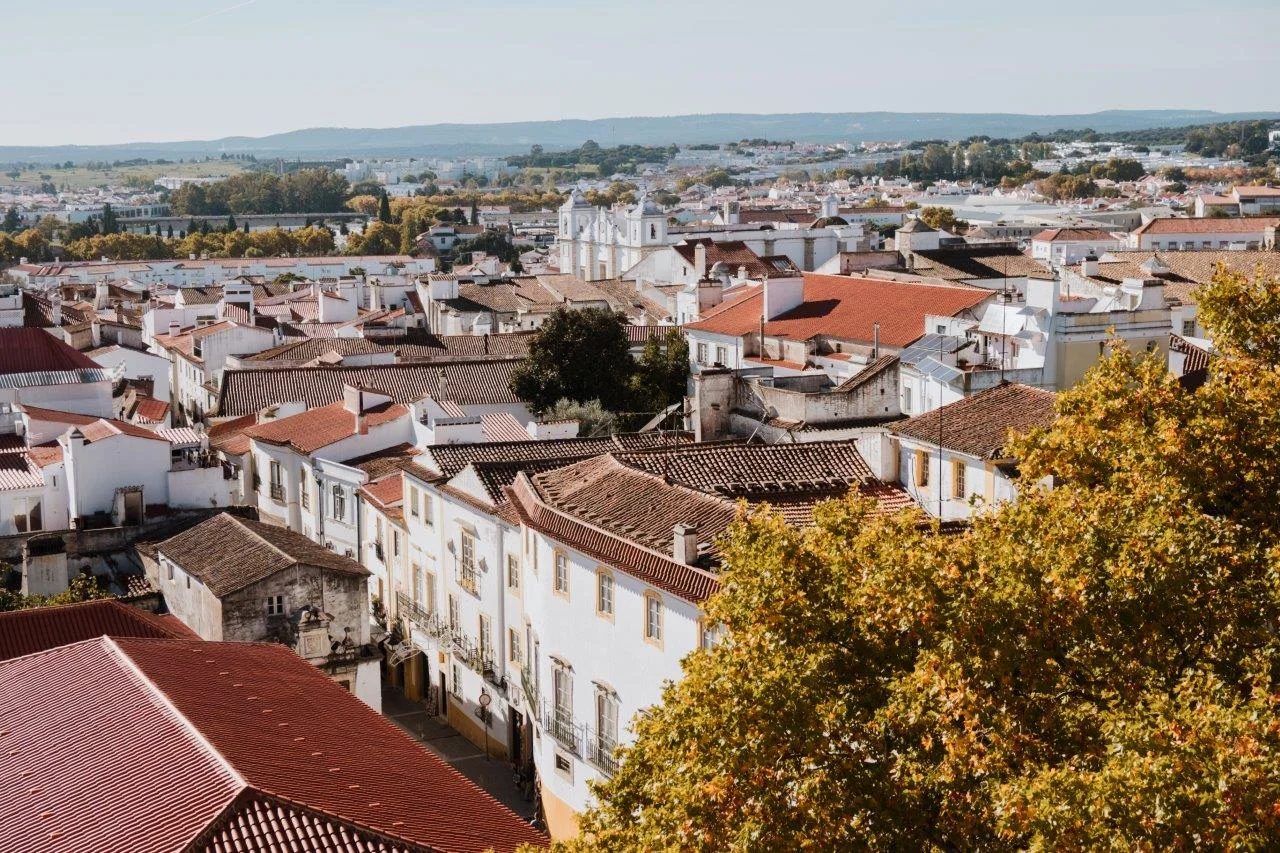
The weekend
Four days in Évora, and the warm-weather outlier of the whole list. Late October in the Alentejo still runs to 22–25°C, the light is enormous, and the landscape — rolling wheat plains, cork oaks with their trunks stripped red, whitewashed villages on low hills — is empty in a way nowhere else on this list is.
The cycling is flat to gently rolling on quiet back roads with almost no traffic, which makes it one of the least stressful options here. Évora itself is a walled UNESCO city with a Roman temple in the middle, a cathedral, and a chapel lined with the bones of 5,000 monks. And the wine is generous, cheap and — in the talha tradition — made in clay amphorae by a method the Romans would recognise.
A little history
Évora was Roman Ebora Liberalitas Julia, and the temple in its centre survived because it was walled up and used as a butcher's shop until the 19th century. The city was the seat of the Portuguese court for long stretches under the House of Avis, and its university was founded by the Jesuits in 1559. Out on the plain, the Almendres Cromlech predates the Egyptian pyramids by well over two thousand years. And the talha wine tradition — fermentation in buried clay amphorae — has run unbroken here since Roman occupation, making it one of the oldest continuous winemaking methods in Europe.
What it costs
Per person for the whole weekend, priced for a party of four — two twin rooms, or one whole place between you. Everything but the bed is fixed, so where you sleep is the only row that moves and the only one shown as a range.
| Per person | |
|---|---|
| Getting there, both ways | £166 |
| Three nights | £55–150 |
| Bikes and getting about | £34 |
| Eating, drinking and tastings | £150 |
| The weekend, per person | ~£400–500 |
Where to sleep
| Option | Per person |
|---|---|
| Hotels — two twin rooms | |
| Stay Hotel Évora Centro and similar inside the walls | €26 a night £65 for three |
| Convento de São Paulo, or the Évora Olive Hotel | €58 a night £150 for three |
| Airbnb and self-catering — one whole place | |
| The typical Évora listing | €22 a night £55 for three |
Évora is the one place on the site where rentals run dearer than hotels — about 24% dearer on average.
Eating and drinking
| What | Each |
|---|---|
| A full Alentejo dinner | €25–30 |
| Mains at a village place | €9–12 |
| A glass of Alentejo red | €3–5 |
| Tastings at the herdades | €10–20 |
The £150 above assumes the middle of this list: a cheap lunch, an ordinary dinner, one good one over the weekend, and wine throughout. It does not change with the room.
Day by day
Friday Arrive & Évora within the walls
- Morning flight to Lisbon; train east across the plain into Évora by late afternoon.
- The old city inside its walls: the Roman temple, the cathedral, and the Capela dos Ossos — a chapel lined floor to ceiling with the bones of some 5,000 monks, over a door reading 'we bones that are here await yours'.
- Evening: dinner in a tiled tasca. Alentejo food is peasant cooking of a very high order, and absurdly cheap by London standards.
Saturday Out across the montado, the megaliths on the way back
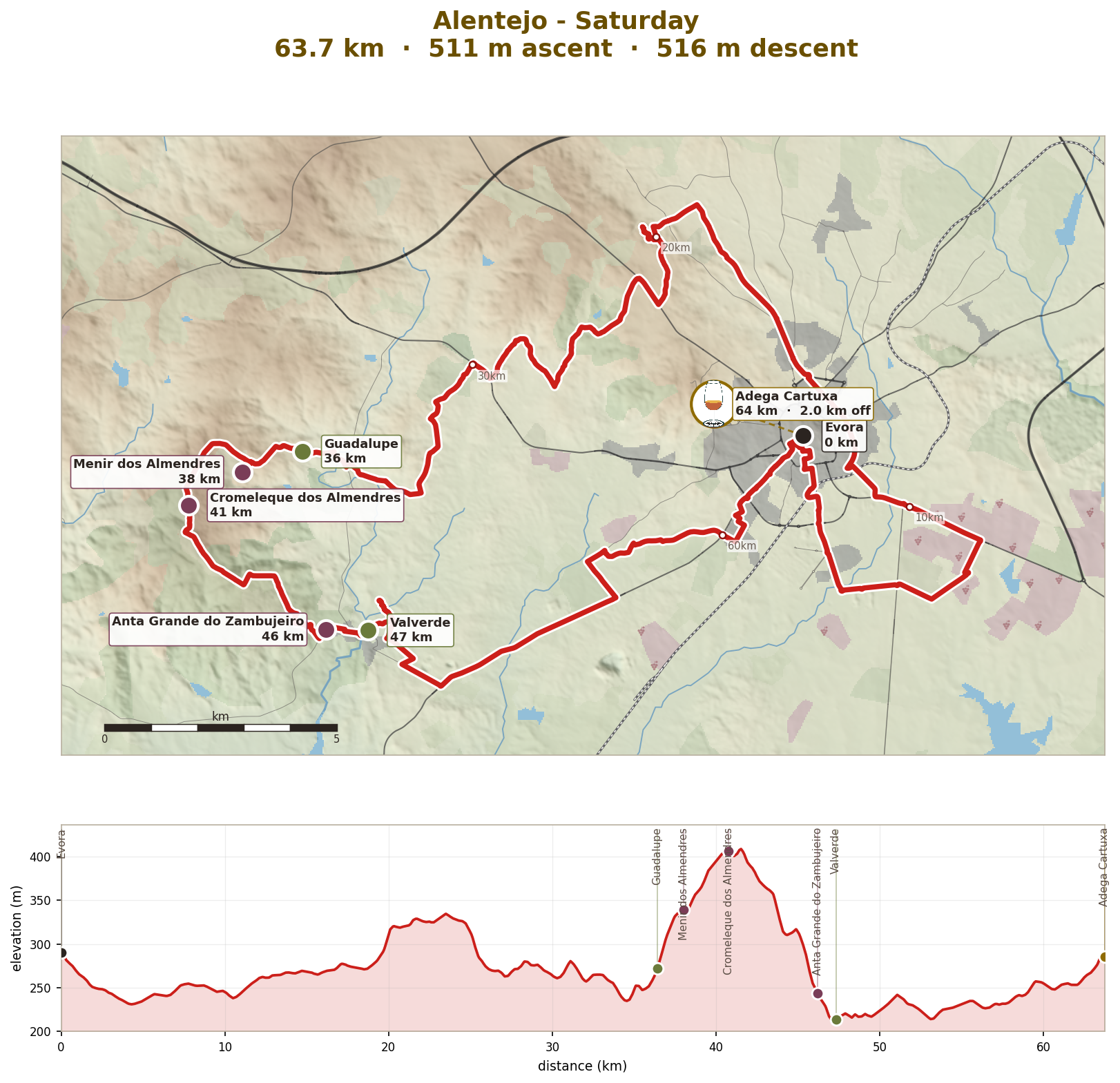
- 63.7km with 511m of ascent. Not the flat day the Alentejo suggests — Évora sits at 300m and the ground rolls the whole way. The heat, not the gradient, is what governs it.
- West out of the walls onto empty roads through the cork oak montado. Portugal produces roughly half the world's cork; the trees are stripped every nine years and left a startling rust red with the year painted on the trunk.
- The megaliths come in the back half, which is the right way round. The Menir dos Almendres at 38km — a single standing stone, aligned on what comes next — then the Cromeleque dos Almendres at 41km: ninety-five stones in a horseshoe, put up around 6000 BC. Older than Stonehenge by two thousand years, and on most days you will have it to yourself.
- Anta Grande do Zambujeiro at 46km, down a dirt track off the road: the largest dolmen in Iberia, chamber stones six metres high, standing in a field with a tin roof over it.
- Adega Cartuxa at 63km, on the edge of Évora and two kilometres off the line — a former Jesuit estate making Pêra-Manca alongside excellent everyday wine, and the only serious visitable producer near the city. At the end of the ride rather than the start of it, which is the point of going anticlockwise.
- Back inside the walls for a long dinner.
63.7 km · 511 m of ascent · 212–407 m
Sunday East across the plain to Monsaraz
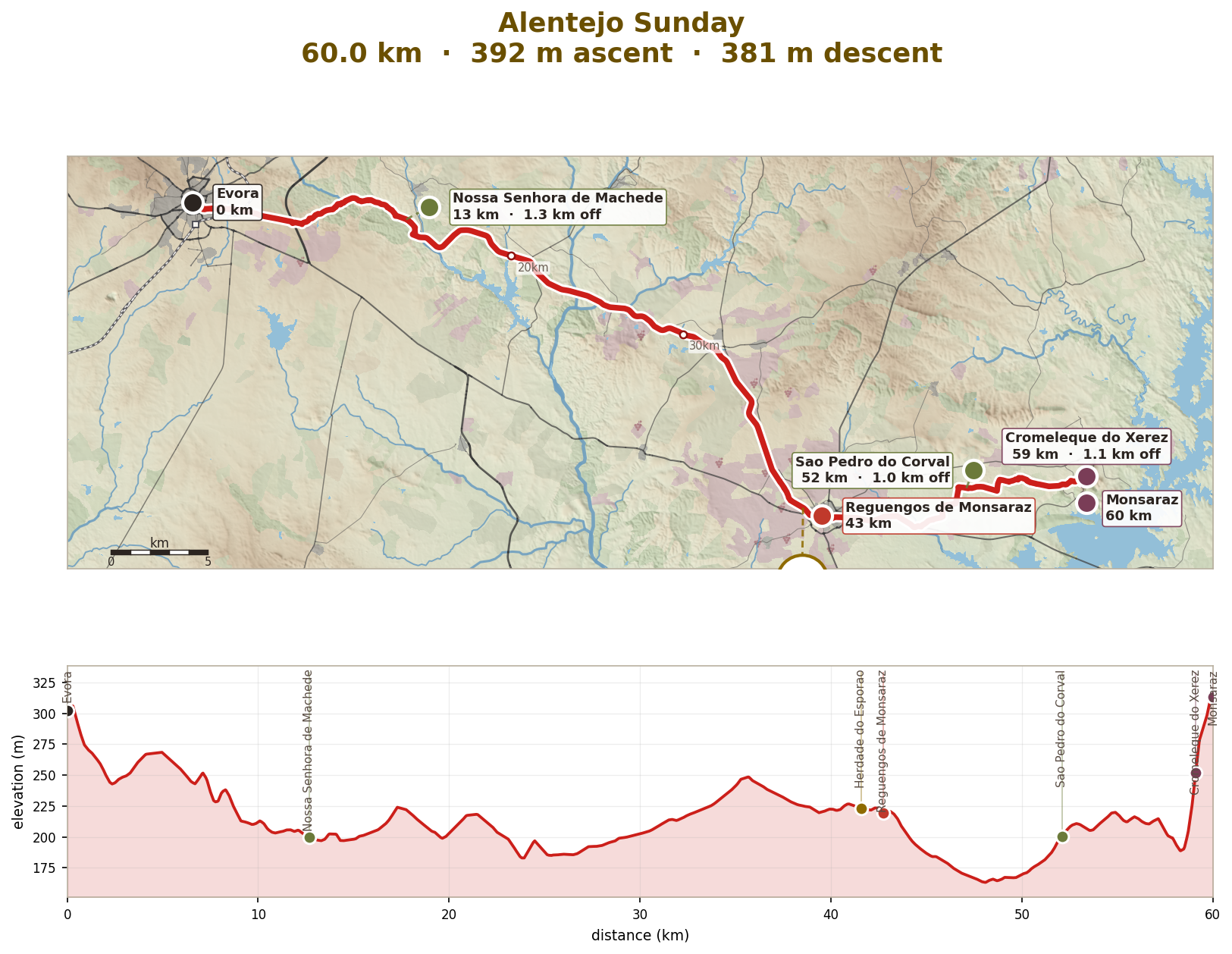
- 60km with 392m of ascent, one way, finishing on the hill at Monsaraz — so arrange the transfer back before you set off.
- Out through Nossa Senhora de Machede at 13km and onto the open plain: thirty kilometres of nothing much, which in the Alentejo is the attraction rather than the drawback.
- Reguengos de Monsaraz at 43km is lunch, and the town at the centre of the appellation. Herdade do Esporão lies three kilometres south — a large, beautifully run estate with a restaurant, an olive mill and the best visitor operation in the region. Book it; a 60km day with one cellar on it should be the right cellar.
- São Pedro do Corval at 52km, one of the largest pottery centres in Portugal — and the place the talha jars come from, which makes it more than a souvenir stop.
- Cromeleque do Xerez at 59km, a kilometre off the road: a stone circle taken apart and re-erected on higher ground when the Alqueva reservoir drowned its original site.
- Monsaraz, walled and white on its hill above the lake. It sits at the centre of the Alqueva Dark Sky Reserve — the first Starlight Tourism Destination anywhere, and about the darkest accessible sky in western Europe. Which is an argument for staying up there until after dark rather than transferring straight back.
- The gentler alternative is south to the talha villages around Vila de Frades and Vidigueira, where wine still ferments in man-high clay amphorae buried to the shoulder, an unbroken Roman technique. They are traditionally broached on St Martin's Day, 11 November. Too far to ride from Évora — transfer down and loop there instead.
60.0 km · 393 m of ascent · 163–313 m
Monday Home
- Morning in Évora — the aqueduct running into the town with houses built into its arches, or the market.
- Train or transfer to Lisbon; evening flight home.
When to go
Spring — March to May
12–24°C, and the plains are green and covered in wildflowers — the best-looking season by far, and quite different from the parched image of the region. Storks nest on every chimney and pylon.
Summer — June to August
20–36°C and frequently higher. Genuinely dangerous heat for cycling in July and August; if you come then, ride at dawn and spend the afternoons in a cellar or a pool.
Autumn — September and October
15–28°C. September is still hot but manageable, October is close to perfect — warm, dry, empty roads and the harvest finished.
When to go
April or October. Spring for the wildflowers and green plains; October for warmth without danger.
Festivals
None of this weekend assumes a festival. The rides work on any weekend of the year. If you are there on 11 November the talha pots are broached, and the thing to do is shorten the Saturday and spend the afternoon in a village adega drinking wine straight from the clay. The trade is worth stating plainly: on a festival weekend the growers are behind a stand in the square rather than showing visitors round a cellar, so book private tastings weeks ahead or accept that some will be shut, and expect beds to be scarcer, dearer and gone months in advance.
Spring
Festival Terras sem Sombra — spring
Concerts in the churches and monasteries of the Alentejo, pairing sacred music with the landscape.
Semana Santa, Évora — Easter
Processions through the walled city, and the town at its most atmospheric.
Summer
Feira de São João, Évora — late June
The largest fair in the Alentejo: a week of music, food and regional crafts in the middle of the city.
Autumn
Talha wine broached — 11 November
The clay amphorae are opened on Saint Martin's Day and the wine drawn straight from the pot, with chestnuts and água-pé. The single most characteristic thing the region does.
Getting there
From London, per person, assuming bikes are hired locally rather than flown. Fares checked September 2026 and converted at €1 to 86p.
| Leg | Time | Cost |
|---|---|---|
| The flight | ||
| easyJet, BA, TAP or Ryanair from Gatwick, Heathrow, Stansted or Luton to Lisbon (LIS), many daily | 2h 40 | £70 |
| Airport to the station | ||
| Metro to Lisboa Oriente (€1.80) | 0h 25 | £2 |
| Out to Évora | ||
| Train across the Alentejo plain (€13) | 1h 30 | £11 |
| Waiting and one change | 1h 05 | — |
| Door to door, one way | 5h 40 | £83 |
| Both ways | £166 | |
A pre-booked transfer from the airport does it in about an hour and a half direct, and is simpler with luggage.
Bike hire
Assumes hybrids.
| Shop | Rate |
|---|---|
| Galácio Bike, Évora — conventional and electric, delivered, helmets included | rates on request |
| Sorte Verde — electric bikes, and much cheaper by the week than by the day | €15 a day €70 a week |
| MegaSport Travel — delivers anywhere in the Alentejo | rates on request |
Getting about
| What | Cost |
|---|---|
| Bike hire, Saturday and Sunday | £26 |
| Trains and buses across the Alentejo, allow | £8 |
| Getting about, whole weekend | £34 |
The wineries
Adega Cartuxa
The most visitable serious producer near the city, making the celebrated Pêra-Manca alongside excellent everyday wines. Tours and tastings scheduled.
Herdade do Esporão
A large, beautifully run estate with a restaurant, olive oil, and one of Portugal's best visitor operations. Book ahead.
A talha producer
Amphora wine in buried clay pots, made as the Romans did. Small, informal and fascinating — ask the hotel to arrange.
Herdade do Mouchão
Alicante Bouschet trodden in lagares and aged in enormous old vats; a cult wine and a working farm.
The wines
Big, ripe, generous reds from Aragonez (Tempranillo), Trincadeira, Alicante Bouschet and Touriga Nacional — soft, warm and remarkably cheap for the quality. Whites from Antão Vaz and Arinto. And vinho de talha: amphora-fermented wine, cloudy, savoury and unlike anything else in the modern wine world.
Eat & drink
| Friday | Tasca dinner in the walled city |
| Saturday | Picnic among the cork oaks; Cartuxa tasting |
| Sunday | Long lunch at Esporão, or a talha village |
| Monday | Market breakfast in Évora |
The food
Porco preto (black Iberian pig, acorn-fed in the cork oak groves), açorda (bread and coriander soup), migas, ensopado de borrego, sheep's cheeses like Serpa and Nisa, and convent desserts made of egg yolk and sugar — sericaia with an Elvas plum. Prices will startle a London group.
Where to stay
Convento do Espinheiro
A 15th-century convent turned hotel, with cloisters, a chapel and a cellar restaurant.
Pousada Convento de Évora
A 16th-century monastery, state-run pousada, with the best position in the city.
Albergaria do Calvário
Smaller and better value, in a converted olive-oil mill just inside the walls.
Practical
- Heat is the constraint here, not gradient. Both days roll — 511m on the Saturday, 392m on the Sunday — but the real limit is shade, of which the montado has almost none. Start early and treat late morning as the cut-off for anything exposed.
- The megalith approaches are unsurfaced. Both Almendres and Zambujeiro are reached down dirt tracks, corrugated in places — fine on 32mm or wider, miserable on 25s.
- The Sunday finishes at Monsaraz and needs a transfer home. Reguengos has no station; Évora does. Book the pick-up when you book the beds, and consider making it a late one so you get the dark sky.
- Portugal allows cyclists 0.5 g/l of blood alcohol, the same limit as drivers. See the country-by-country table.
- The warm option. Dry and bright well into the autumn — the only destination here where you would ride in short sleeves.
- Remarkable value for food and wine — only Moravia and the Canal du Midi come in lower, and Portugal in the shoulder season is very cheap indeed.
- Longest journey after Chablis — 5½ hours door to door. A pre-booked transfer from Lisbon is worth it for two to four people.
- Roads are flat and empty, which makes this among the least stressful cycling on the list, though there are few dedicated cycle paths — you share quiet back roads.
- Talha wine is broached on 11 November, and the single most characteristic thing the region does, if a November trip ever tempts.
- Check sunset before you plan the last leg. Any day that finishes with a ride home wants an hour of light in hand, and that hour disappears fast either side of the equinoxes.
- Visit Alentejo — the official regional tourist board
- Alentejo Wines (CVRA) — the wine commission — producers, the wine route, talha wine
- Évora Tourism — the walled city, the temple and the Capela dos Ossos
- Rota dos Vinhos do Alentejo — the signposted wine route and which estates receive visitors