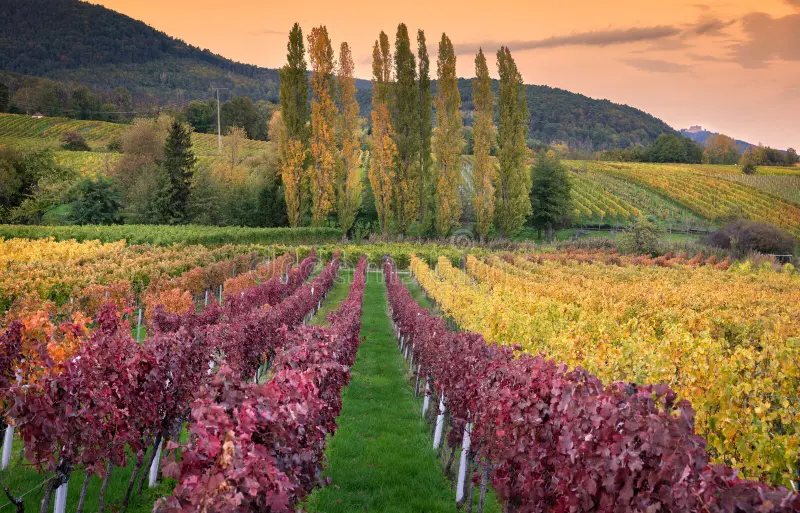
The weekend
Four days in the Pfalz, the warmest and easiest of the German wine regions: a signed road running eighty kilometres along the foot of the Haardt hills, villages of half-timbered houses every few kilometres, and figs and almonds growing beside the vines. The riding is gentle and the railway shadows the whole route, so no day has to end where it started.
If your dates fall at the end of September the Deutsches Weinlesefest is on in Neustadt — the German Wine Harvest Festival, eighteen days of it, ending with the grand winegrowers' parade and the crowning of the German Wine Queen on the closing Sunday. Worth planning around if you can; not something the weekend needs.
The Pfalz is Germany's warmest and second-largest wine region — figs and almonds grow along the Deutsche Weinstraße, the wine road that runs 85km from Bockenheim to the French border. The riding is flat to gently rolling along the foot of the Haardt hills, with the villages of the Mittelhaardt — Deidesheim, Forst, Wachenheim, Ruppertsberg — strung a few kilometres apart, each with more good producers than seems reasonable.
A little history
The Romans planted here, and a sealed bottle of Roman wine from around 325 AD — the oldest known liquid wine in the world — was dug up near Speyer and sits in the museum there. The Weinstraße itself was laid out in 1935, the first designated wine road in Germany. And Hambach Castle above Neustadt is where, in May 1832, tens of thousands gathered under black-red-gold banners to demand a united, free Germany — the flag they flew became the national one, and the Hambacher Fest is taught in every German school.
What it costs
Per person for the whole weekend, priced for a party of four — two twin rooms, or one whole place between you. Everything but the bed is fixed, so where you sleep is the only row that moves and the only one shown as a range.
| Per person | |
|---|---|
| Getting there, both ways | £174 |
| Three nights | £80–165 |
| Bikes and getting about | £36 |
| Eating, drinking and tastings | £165 |
| The weekend, per person | ~£460–540 |
Where to sleep
| Option | Per person |
|---|---|
| Hotels — two twin rooms | |
| Guesthouses along the Weinstraße | €36 a night £95 for three |
| Hotels in Neustadt and the wine villages | €64 a night £165 for three |
| Airbnb and self-catering — one whole place | |
| The typical Weinstraße listing | €32 a night £80 for three |
The figure is for Wachenheim, the next village along and the nearest market with published data.
Eating and drinking
| What | Each |
|---|---|
| A Mittagstisch | €8–13 |
| Saumagen and Riesling in a Weinstube | €18–30 |
| Dinner with a bottle | €35–55 |
| Tastings along the Deutsche Weinstraße | €5–15 |
The £165 above assumes the middle of this list: a cheap lunch, an ordinary dinner, one good one over the weekend, and wine throughout. It does not change with the room.
Day by day
Friday Arrive & Neustadt
- Late-morning flight; train via Mannheim into Neustadt by mid-afternoon.
- Neustadt has a proper half-timbered old town and a good handful of wine bars round the Marktplatz, which is enough for a first evening in any month.
- If your dates land on the Deutsches Weinlesefest, you will not need telling — it takes over the whole town for eighteen days from late September, with growers' stands in the streets, a funfair and the nostalgic Bon Vivant mirror-palace. Lovely, and busy; the old-town bars are the escape.
Saturday The plain first, the cellars last
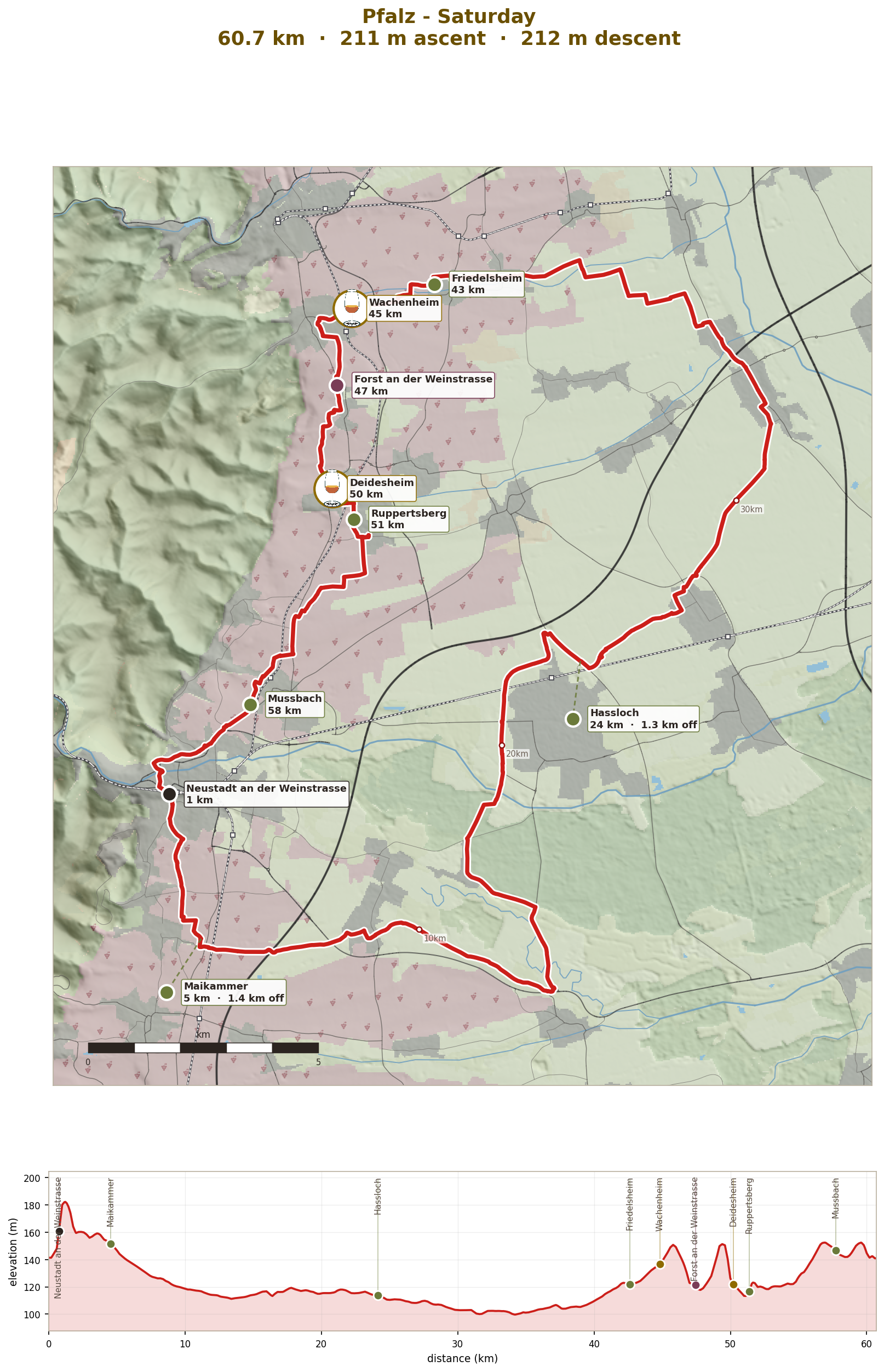
- 60.7km with 211m of ascent — one of the flattest days on the whole list, ridden anticlockwise so the three famous villages fall in the last fifteen kilometres rather than the first fifteen.
- South to Maikammer at 5km, then east and out into the Rhine plain: Haßloch at 24km is the far corner. Level, quiet, and with no wine on it at all — this is the stretch that turns three villages into a day's ride, and it is much better done on fresh legs than on four tastings.
- Back to the wine road at Friedelsheim, 43km.
- Wachenheim at 45km, and Dr. Bürklin-Wolf — biodynamic, farming many of the finest Mittelhaardt parcels.
- Forst at 47km, where the Jesuitengarten and Kirchenstück are among the greatest Riesling sites in Germany. Dark basalt was carted down from the hills centuries ago to hold the day's heat in the soil; walk the field paths between the two.
- Deidesheim at 50km — half-timbered, immaculate, the prettiest village on the Weinstraße, and home to Reichsrat von Buhl (1849) and Bassermann-Jordan (1718), both of which pour without ceremony and stand a few hundred metres apart.
- Then Ruppertsberg at 51km and vineyard lanes home through Mussbach — nine flat kilometres after the last glass.
60.7 km · 212 m of ascent · 100–182 m
Why this way round
Ridden the other way the same loop puts Deidesheim at 10km, Forst at 13km and Wachenheim at 16km, and then hands you forty-five kilometres of empty plain to get home across. Anticlockwise the cellars land at 45–50km with nine flat kilometres left, which is how the rest of these weekends are built.
The one argument for going clockwise is a doubtful forecast: it reaches the good villages inside the first hour, so a wet afternoon costs you the plain rather than the wine.
Sunday South to the Haardt villages, home over Hambach Castle
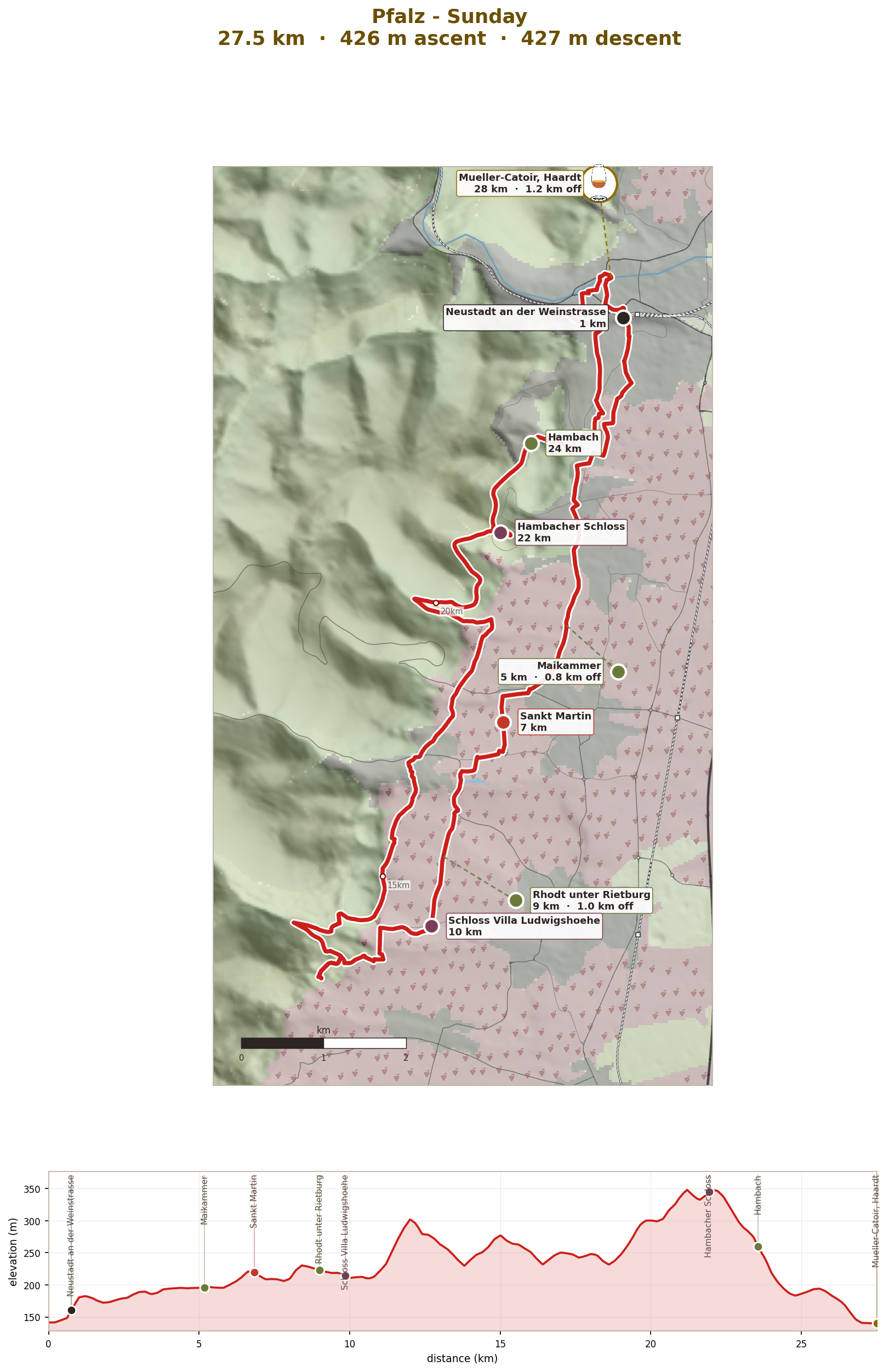
- 27.5km with 426m of ascent — short, and ridden anticlockwise so the climbing comes late and the tasting comes last.
- South first, along the flat foot of the Haardt. Maikammer at 5km, then Sankt Martin at 7km, tucked against the hills and about the prettiest village on the Weinstraße — early for lunch, but the right place to stop for coffee.
- Rhodt unter Rietburg at 9km, and the Theresienstraße — a street of old estates under chestnut trees, with a Traminer vineyard behind it planted around 1600 and still producing.
- Schloss Villa Ludwigshöhe at 10km — Ludwig I’s summer palace, reopened after six years of restoration — and the Rietburgbahn beside it, a chairlift that carries you 220 metres up to a ruined castle at 550m in ten minutes. From the terrace: the whole Rhine plain, and the cathedrals at Speyer and Worms.
- Then the turn for home and the only real climb of the day. Hambacher Schloss at 23km and 331m. In 1832 some thirty thousand people marched here demanding German unity and civil liberties, flying black-red-gold; it is regarded as the birthplace of the German flag and of German democracy. The Saturday passes a kilometre and a half below it without going up.
- Down through Hambach at 24km, and Müller-Catoir at 27km in Haardt on the edge of Neustadt — one of the benchmark Pfalz estates, for Riesling and for Rieslaner. Ring ahead rather than turning up. Three hundred metres later you are back at the hotel.
- If the Weinlesefest is on, the Winzerfestumzug — the grand winegrowers’ parade, floats, bands and the German Wine Queen — comes through Neustadt on the closing Sunday afternoon. This ride is short enough to be back for it with time to spare.
27.5 km · 427 m of ascent · 140–348 m
Opening times on the Sunday
Rietburgbahn: Saturdays, Sundays and holidays 09.30–18.00 from 1 May to 24 October, 10.00–17.30 in spring and to 8 November. €8.50 return, €5.50 one way. Last ride fifteen minutes before closing. Cash, or card over €10.
Schloss Villa Ludwigshöhe: Wednesday to Sunday and holidays, 10.00–18.00 from 14 March to 31 October, last admission 17.00. Closed Mondays and Tuesdays, and closed 10–20 August 2026 for building work — on those dates the chairlift still runs and the view is the point anyway.
Monday Home
- Slow morning — the Neustadt old town, or a last vineyard walk.
- Train to Frankfurt Airport; evening flight home.
When to go
Spring — March to May
8–19°C, and this is the warm corner of Germany — almonds flower along the Weinstraße in March, figs and lemons grow in the gardens, and spring arrives a fortnight before it does anywhere else in the country.
Summer — June to August
17–28°C, often more. Hot, sunny and busy with terrace life; the Palatinate forest gives shade on the western side when the plain gets heavy.
Autumn — September and October
10–19°C, red vine leaves along the whole road, and the biggest wine festivals of the German year. September is generally settled; October cools quickly.
When to go
Late March for almond blossom, or September for the festivals. The Pfalz is the one destination here with a genuinely compelling spring case.
Festivals
None of this weekend assumes a festival. The rides work on any weekend of the season. If your dates land on Erlebnistag in late August the Weinstraße is closed to cars and that is the day to ride it. On Wurstmarkt or Weinlesefest weekends, ride in the morning and go into Bad Dürkheim or Neustadt afterwards — both are on the railway, so nobody has to ride home. The trade is worth stating plainly: on a festival weekend the growers are behind a stand in the square rather than showing visitors round a cellar, so book private tastings weeks ahead or accept that some will be shut, and expect beds to be scarcer, dearer and gone months in advance.
Spring
Mandelblütenfest, Gimmeldingen — March
The almond trees along the Weinstraße flower before anything else in Germany, and the villages celebrate it. The Mandelblütenweg is a signed route through the blossom.
Summer
Erlebnistag Deutsche Weinstraße — late August
The Wine Road closed to cars for a day, with music and tastings strung along it. A cyclist's festival by design.
Autumn
Wurstmarkt, Bad Dürkheim — September
Claimed as the largest wine festival on earth, held beside the world's biggest barrel. Enormous, boisterous and not remotely refined.
Deutsches Weinlesefest, Neustadt — late September into October
The German Wine Harvest Festival, with the grand winegrowers' parade on the closing Sunday.
Getting there
From London, per person, assuming bikes are hired locally rather than flown. Fares checked September 2026 and converted at €1 to 86p.
| Leg | Time | Cost |
|---|---|---|
| The flight | ||
| BA, Lufthansa or Ryanair, London to Frankfurt (FRA), many daily | 1h 40 | £65 |
| Frankfurt to the Weinstraße | ||
| Train via Mannheim to Neustadt an der Weinstraße (€25). Neustadt and Deidesheim are both on the railway, so bases and rides can be mixed freely | 1h 15 | £22 |
| Waiting and one change | 0h 50 | — |
| Door to door, one way | 3h 45 | £87 |
| Both ways | £174 | |
Bike hire
Assumes hybrids.
| Shop | Rate |
|---|---|
| Postel & Böhl, Mußbacher Landstraße 20, Neustadt — bikes and e-bikes | rates on request |
| Fahrrad Trimpe, Adolf-Kolping-Str. 126, Neustadt — a proper bike shop, so useful if something breaks | rates on request |
| Palatina, Weinstraße 63, Deidesheim — handy if you base there instead | rates on request |
None of the three publishes a rate, and the regional tourist board keeps the current list of hire points along the Deutsche Weinstraße.
Getting about
| What | Cost |
|---|---|
| Bike hire, Saturday and Sunday | £26 |
| Regional trains along the Weinstraße, allow | £10 |
| Getting about, whole weekend | £36 |
The wineries
Reichsrat von Buhl
One of the Pfalz's historic estates, with grand cru sites in Forst and Deidesheim. Tasting room open regular hours.
Geheimer Rat Dr. von Bassermann-Jordan
Baroque cellars in the middle of the village and a superb range of dry Rieslings.
Weingut Dr. Bürklin-Wolf
One of Germany's benchmark estates, farming many of the finest Mittelhaardt parcels.
The festival stands
Dozens of Pfalz producers pouring in the town, which is the efficient way to taste widely without a single appointment. Outside the festival the equivalent is Deidesheim: three of the four estates above are within a few hundred metres of each other, and the village is ten minutes from Neustadt by train if the legs have gone.
The wines
Riesling above all, and the Pfalz style is richer and rounder than the Mosel's — riper fruit, more body, less racing acidity. Alongside it: Weissburgunder and Grauburgunder (Pinot Blanc and Gris), Spätburgunder, and Dornfelder, the deeply coloured red that Germany drinks and rarely exports.
Eat & drink
| Friday | Festival stands in Neustadt |
| Saturday | Lunch in Deidesheim; Saumagen if anyone dares |
| Sunday | Parade day — Federweißer and Zwiebelkuchen |
| Monday | Breakfast, then the train |
The food
Saumagen — stuffed pig's stomach, sliced and fried, and rather better than it sounds; it was Helmut Kohl's party piece for visiting heads of state. Plus Leberknödel, Bratwurst, Zwiebelkuchen with Federweißer, and Pfälzer chestnuts roasted at the festival stands.
Where to stay
Deidesheimer Hof
The village's grand old hotel, with a serious kitchen and Saumagen on the menu. A short train hop from the festival.
Hotel Palatina
Practical and central, and on the parade weekend the difference between walking home and not.
Ketschauer Hof
A wine estate's manor house turned hotel, with a Michelin-starred restaurant attached.
Practical
- Germany is the outlier: 1.6 g/l before a cyclist is automatically unfit, but 0.3 g/l is enough to be prosecuted if you ride badly or come off. A conviction on a bicycle can cost you your car licence. See the country-by-country table.
- Two quite different weekends here. Late September and early October for the Wurstmarkt and the Weinlesefest parade; March for almond blossom along the Weinstraße, when the Pfalz flowers before anywhere else in Germany.
- Book accommodation early. The Weinlesefest fills Neustadt; Deidesheim is 10 minutes away by train and much calmer.
- Germany's warmest wine region — expect the mildest riding weather of the German and French options.
- Hambach Castle is a proper climb but short, and the history is genuinely worth the effort.
- Bike hire in Neustadt and along the Weinstraße; the route is flat enough that hybrids are fine.
- Deutsches Weinlesefest — official — the festival programme, parade route and dates
- Pfalz Wine Board — the region, its producers and the Weinstraße
- Deutsche Weinstraße — the 85km wine road, village by village
- Hambach Castle — the 1832 festival and the birth of the German flag