The weekend
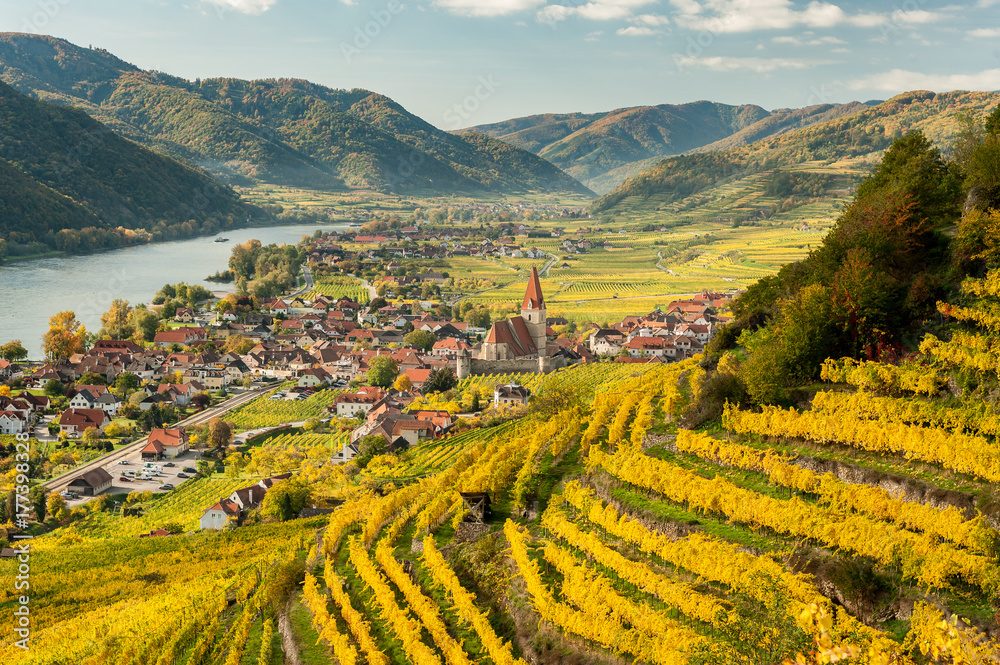
Four days on the Danube between Krems and Melk — a 36km stretch of river valley so concentrated in castles, abbeys, terraced vineyards and riverside villages that UNESCO listed the whole thing in 2000.
It may be the single best cycling proposition on the list. The Donauradweg runs along both banks, flat, surfaced, waymarked and largely car-free, with little ferries crossing the river so you can compose any loop you like. Add Grüner Veltliner and Riesling of genuine world class, Heuriger taverns where the grower pours their own, and — in October — *Sturm*, the cloudy half-fermented new wine, which is the Austrian cousin of the Mosel's Federweißer.
A little history
The valley has been settled since the Palaeolithic — the Venus of Willendorf, a 30,000-year-old limestone figurine and one of the oldest artworks ever found, was dug up beside the Danube here in 1908. Charlemagne granted vineyards to Bavarian monasteries in the 8th century, which is why abbeys still own vines. And in 1192 Richard I of England, shipwrecked and travelling in disguise, was recognised and imprisoned at Dürnstein by Duke Leopold V, who was still furious about a banner thrown down at Acre; the ransom that freed him was a substantial part of England's annual revenue.
What it costs
Per person for the whole weekend, priced for a party of four — two twin rooms, or one whole place between you. Everything but the bed is fixed, so where you sleep is the only row that moves and the only one shown as a range.
| Per person | |
|---|---|
| Getting there, both ways | £168 |
| Three nights | £50–215 |
| Bikes and getting about | £61 |
| Eating, drinking and tastings | £145 |
| The weekend, per person | ~£420–590 |
Where to sleep
| Option | Per person |
|---|---|
| Hotels — two twin rooms | |
| Gästehaus and Heuriger rooms in Weissenkirchen and Spitz | €38 a night £95 for three |
| Three- and four-star hotels in Krems and Dürnstein | €84 a night £215 for three |
| Airbnb and self-catering — one whole place | |
| Entry-level flats in and around Krems | €19 a night £50 for three |
| The typical Krems listing — a whole flat, and 85% of the market is whole flats | €31 a night £80 for three |
117 active listings in Krems an der Donau, overwhelmingly entire apartments.
Eating and drinking
| What | Each |
|---|---|
| A Heuriger supper — the grower pours their own | €10–20 |
| A restaurant dinner in Krems or Dürnstein | €25–40 |
| A glass of Grüner Veltliner at the cellar door | €3–5 |
| Tastings along the valley | €5–15 |
The £145 above assumes the middle of this list: a cheap lunch, an ordinary dinner, one good one over the weekend, and wine throughout. It does not change with the room.
Day by day
Friday Arrive & Krems
- Morning flight to Vienna; train up the Danube to Krems by mid-afternoon.
- Krems and its old quarter of Stein are a pair of medieval towns grown together, all painted facades and arcaded courtyards.
- Late afternoon: a first Heuriger — the grower's own tavern, a pine branch over the door meaning the new wine is open, cold cuts and bread on the table.
- Dinner in Krems; try the Wachau's Grüner Veltliner with Wiener Schnitzel and see why the Austrians never export enough of it.
Saturday Melk to Krems, downstream and with the wind
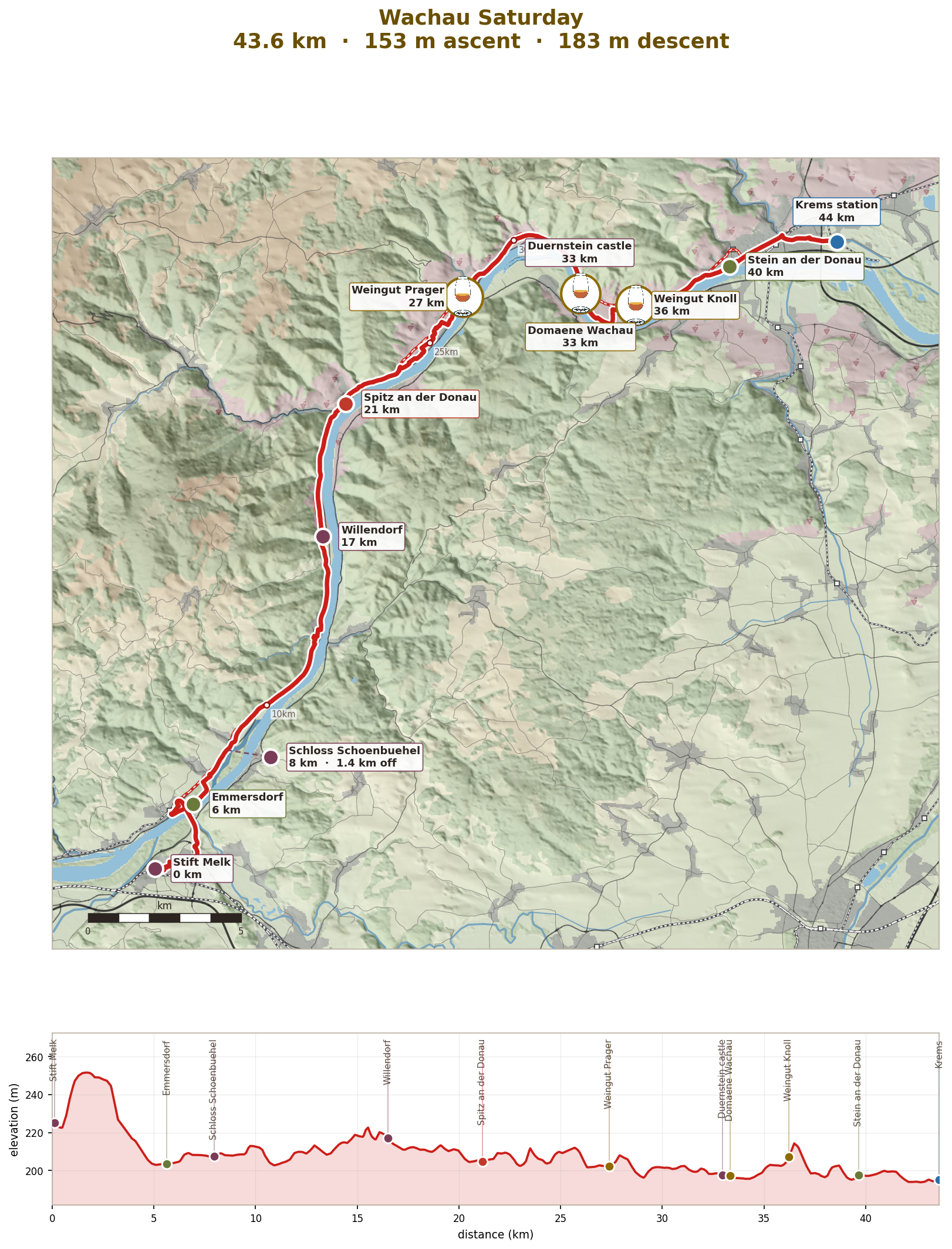
- 43.6km with 153m of ascent — measured, and about as flat as a day's riding gets. Ride it in this direction. Melk to Krems is downstream and the valley's prevailing wind runs up it, which is why every organised trip in the Wachau goes this way and almost nobody goes the other.
- Train up to Melk first thing with the bikes, and start at the abbey: a vast yellow Benedictine pile on a bluff over the river, with a library of eighty thousand volumes.
- The only climb is in the first two kilometres — up to 251m getting out of Melk — and then it is over. Across the bridge to the north bank at Emmersdorf at 6km, and from there the path is car-free the whole way.
- Schloss Schönbühel stands on its rock at the water's edge across the river at 8km, and the ruin of Aggstein sits on the cliff above the south bank a few kilometres later.
- Willendorf at 17km. A lay-by, a marker, and the spot where the Venus was dug out of the loess in 1908 — eleven centimetres of limestone, thirty thousand years old, and the most famous object in Austrian prehistory.
- Spitz at 21km is lunch and the halfway point, with the Tausendeimerberg — the thousand-bucket hill, named for what it yields in a good year — rising straight out of the village.
- Then the wine. Weingut Prager at Weissenkirchen at 27km for terraced Riesling of extraordinary precision; Domäne Wachau at Dürnstein at 33km, a co-operative making a third of the valley's crop to a very high standard, in baroque cellars, open all week and the reliable anchor; and Weingut Knoll at Unterloiben at 36km, the Saint Urban label, if they will have you. Prager and Knoll are appointment-only and small.
- Dürnstein at 33km is the picture: the blue-and-white baroque tower on the water, and above it the ruined castle where Richard the Lionheart was held for ransom in 1192, caught on his way home from crusade.
- Into Stein and Krems — two medieval towns grown together — and the station at 44km. The Wachaubahn runs back up the valley if anyone wants to repeat a stretch.
43.6 km · 153 m of ascent · 194–252 m
Sunday South bank out, over on the ferry, home past Dürnstein
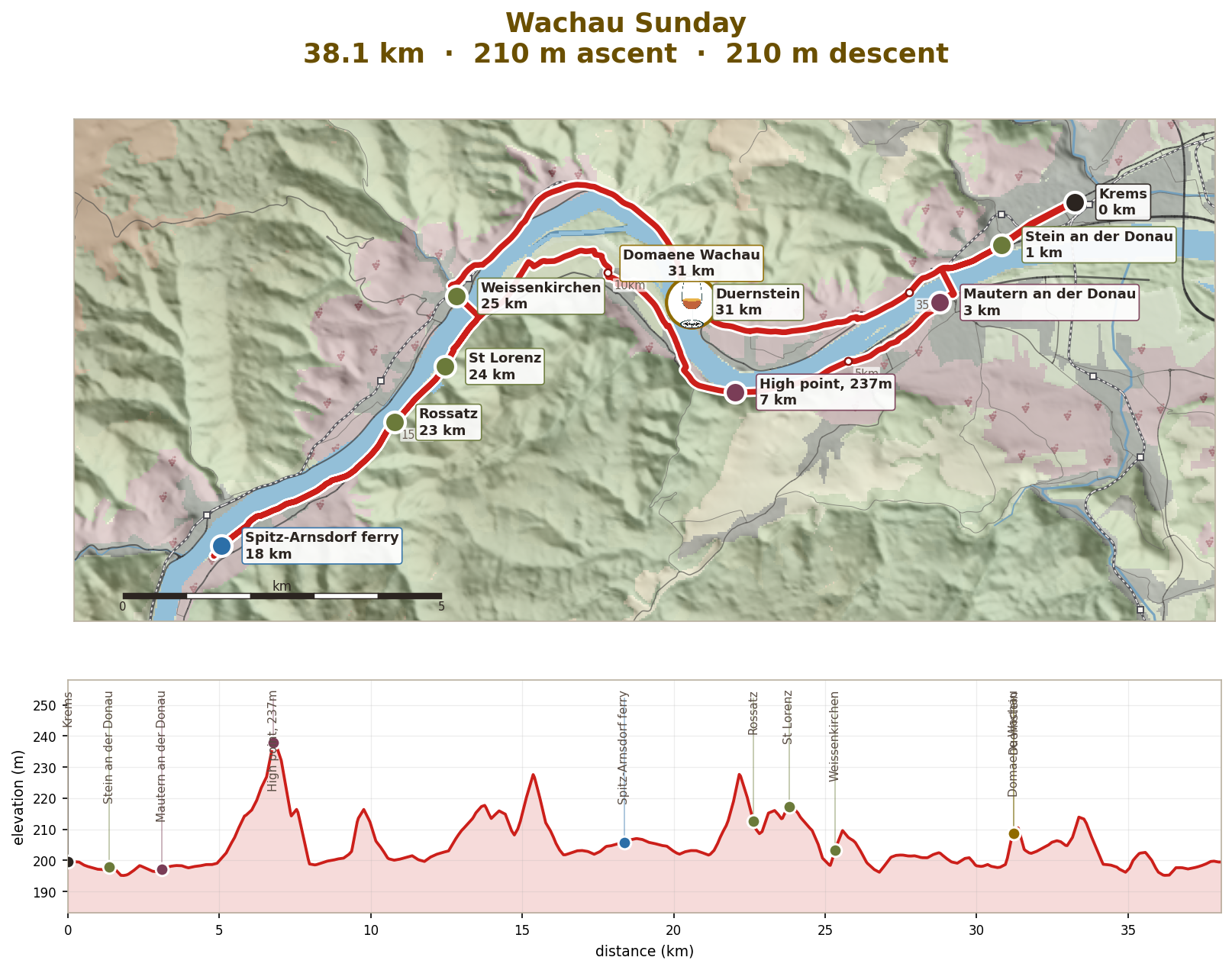
- 38.1km with 210m of ascent — a loop, and lumpier than the Saturday despite being shorter. Nothing sustained: the profile is a saw of forty-metre bumps rather than a climb. Ridden south bank first, so the famous villages come on the way home.
- West out of Krems through Stein at 1km and over the bridge at Mautern at 3km, the Roman fort of Favianis, garrisoned on the Danube frontier.
- The one climb comes early, a short pull to 237m at 7km, with Dürnstein’s castle and the blue church tower directly opposite across the water. The best view of the weekend, and you get it before the legs have gone.
- Then the south bank, which almost nobody rides. St. Lorenz at 14km and Rossatz at 15km: apricot orchards rather than vines, and the Wachau’s marillen are as protected a name as its wine.
- The Spitz–Arnsdorf cable ferry at 18km is the hinge of the day. March to October, weekends 8.15 to 19.30, €4.70 with a bicycle, and it is pulled across on a cable by the current alone. If it is not running, Weissenkirchen–St. Lorenz is the fallback — but it shuts for lunch, roughly 11.45 to 12.30.
- North bank home, and now in the afternoon rather than at nine in the morning: Weissenkirchen at 25km and Dürnstein at 31km, two of the most photographed villages in Austria. Busier than they would have been early, and that is the trade.
- Domäne Wachau at 31km, in Dürnstein — the old Kellerschlössel, and Grüner Veltliner and Riesling from the great terraced sites. Vinothek Mon–Sat 10.00–17.00 April to October, so the timing works on a Saturday but not on a Sunday: check before you build the day around it.
- Krems by 38km. Return the bikes; last dinner on the river.
38.1 km · 210 m of ascent · 195–238 m
Monday Home (via Vienna)
- Morning train back to Vienna, with time for a coffee house — Kaffee und Kuchen, taken slowly, is the correct final act.
- Evening flight to London.
When to go
Spring — March to May
8–19°C, and the apricot orchards flower along the Danube in late March and early April — the region's great spring set piece, with the terraces bare above and blossom below.
Summer — June to August
17–28°C, warm and green, with the Danube path shaded in stretches and the river ferries running frequently. Swimming in the Danube is possible but the current is serious.
Autumn — September and October
9–19°C. The Weinherbst runs through September and October, the terraces turn, and the Grüner Veltliner comes in. Mists on the river in the mornings.
When to go
Late March for apricot blossom, or September for the Weinherbst. The valley is at its most photogenic in both.
Festivals
None of this weekend assumes a festival. The rides work on any weekend of the season. If your dates fall in September or October the Weinherbst is running the length of the valley, which mostly means more cellars open on the route rather than anything to plan around; in April the apricot blossom does the same job. The trade is worth stating plainly: on a festival weekend the growers are behind a stand in the square rather than showing visitors round a cellar, so book private tastings weeks ahead or accept that some will be shut, and expect beds to be scarcer, dearer and gone months in advance.
Spring
Marillenblüte — late March into April
Apricot blossom the length of the valley, celebrated village by village. A different Wachau entirely from the autumn one.
Summer
Apricot harvest — July
Marillenknödel, apricot schnapps and jam in every village, and roadside stalls the whole way along.
Donaufestival, Krems — spring and summer
Contemporary music and performance in a town better known for Riesling.
Autumn
Wachauer Weinherbst — September and October
Two months of cellar openings, tastings and Heuriger evenings up and down the valley.
Getting there
From London, per person. Fares checked September 2026 and converted at €1 to 86p; euro prices are given in the description so you can re-check them.
| Leg | Time | Cost |
|---|---|---|
| The flight | ||
| Gatwick, Luton or Stansted to Vienna (VIE) — easyJet, BA and Ryanair, several a day, from £45–85 each way | 2h 15 | £65 |
| Airport into Vienna | ||
| S7 city train to Wien Mitte, every 30 minutes (€4.40) | 25 min | £4 |
| U4 to Friedensbrücke for Franz-Josefs-Bahnhof — included in the airport ticket | 10 min | — |
| Vienna into the Wachau | ||
| REX to Krems an der Donau, hourly from Franz-Josefs-Bahnhof (€14–20) | 1h 05 | £15 |
| Waiting and changes — an airport and two connections | 1h 00 | — |
| Door to door, one way | 4h 55 | £84 |
| Both ways | £168 | |
The City Airport Train is running as a bus while the line is rebuilt — same €14.90 fare, slower than the S7, and no reason to take it.
Bike hire
Assumes hybrids — the Donauradweg is flat and surfaced throughout.
| Shop | Rate |
|---|---|
| Wachau Explorer, by Krems station — hybrids and e-bikes, tours as well as hire, and the closest to the train | rates on request |
| Aichinger Bicycle + Sport, Krems — the cheap local option, and a proper workshop if something breaks | €15 a day |
| nextbike stands — self-service, no opening hours to work round | €15 for 24h plus €1 to join |
Hire is plentiful in Krems, Dürnstein and Spitz, e-bikes included, and a good many hotels lend bikes free — worth asking before you book anything.
Getting about
| What | Cost |
|---|---|
| Bike hire, Saturday and Sunday | £30 |
| Wachaubahn, Krems to Emmersdorf for the Melk start — €21 single, bicycles carried free with a booked space | £18 |
| Spitz–Arnsdorf cable ferry with a bicycle — €4.70, March to October | £4 |
| Local buses and regional trains in the valley, allow | £9 |
| Getting about, whole weekend | £61 |
The wineries
Domäne Wachau
Around a third of the valley's crop, made to a very high standard and sold at fair prices. Open all week with a proper tasting room — the reliable anchor.
Weingut Knoll
Emmerich Knoll's wines, with the famous Saint Urban label, are among Austria's greatest. Small; email well ahead.
Weingut Prager
Steep terraced Rieslings of extraordinary precision, on the Saturday route.
Any Heuriger with a branch over the door
The grower's own tavern, open by rotation. No booking, no ceremony, and the most Austrian hour of the trip.
The wines
Grüner Veltliner — white pepper, lentil, citrus — and Riesling, grown on terraced primary rock and classified by the growers' own system: Steinfeder (light), Federspiel (medium), Smaragd (ripest, named after the emerald lizards that bask on the terrace walls). Dry, precise and long-lived; the best bottles age for decades and almost nobody outside Austria knows it.
Eat & drink
| Friday | Heuriger cold cuts and Grüner in Krems |
| Saturday | Lunch in Spitz or at Melk abbey |
| Sunday | Riverside dinner in Dürnstein |
| Monday | Coffee and cake in Vienna before the flight |
The food
Wiener Schnitzel done properly, Tafelspitz, Marillenknödel (apricot dumplings), Grammelknödel, smoked river fish, and the Heuriger spread of cold roast pork, Liptauer and dark bread. Pumpkin-seed oil from Styria on everything.
Where to stay
Hotel Schloss Dürnstein
A 17th-century castle-hotel with a terrace directly above the Danube. The view is the whole point.
Steigenberger Avance Hotel
Comfortable, practical, close to the station and the old town.
Gasthof or Winzerhof rooms
Grower-run guesthouses through the valley — simple, cheap and often with their own wine at dinner.
Practical
- Austria allows cyclists 0.8 g/l against 0.5 g/l for drivers — the most forgiving rule on this list, though not a licence to treat it as a target. See the country-by-country table.
- Ride the valley downstream. Melk to Krems is with the current and, more to the point, with the wind — the Wachau funnels a westerly. Going the other way turns a 44km amble into work.
- The Wachaubahn is seasonal — daily in summer, weekends and holidays outside it. It carries bikes and runs along the north bank, so it is both the way up to Melk and the bail-out at Spitz or Weissenkirchen. Confirm it is running in your month before building the day around it.
- The Welterbesteig is a footpath, not a bike route. The terraces are dry-stone walls and steps. For height, the vineyard lanes above Weissenkirchen and Spitz are rideable and steep; the marked trail is not.
- The Sunday loop depends on a cable ferry. Spitz–Arnsdorf runs March to October, 8.15 to 19.30 at weekends, about €4.70 with a bicycle. Weissenkirchen–St. Lorenz is the alternative but closes for lunch, roughly 11.45 to 12.30. Dürnstein–Rossatz is the third. Pick one and check it on the morning.
- Arguably the best flat cycling on the whole list, and unlike the Mosel it comes with abbeys, castles and a UNESCO valley.
- Use the ferries. Little cable ferries cross the Danube at several points, so you can ride out on one bank and home on the other. They run into late October but check the season.
- Bike hire is plentiful in Krems, Dürnstein and Spitz, e-bikes included, and many hotels lend them.
- Sturm is a trap. It tastes like grape juice, is well on its way to being wine, and is still fermenting in your glass. Pace accordingly.
- Check sunset before you plan the last leg. Any day that finishes with a ride home wants an hour of light in hand, and that hour disappears fast either side of the equinoxes.
- Danube Cycle Path — official — the Donauradweg, stage by stage, with bike-friendly hosts
- Wachau Tourism — official regional tourist board — villages, ferries, events
- Vinea Wachau — the growers' association and the Steinfeder/Federspiel/Smaragd system
- Austrian Wine — the national wine board — regions, producers and visiting