The weekend
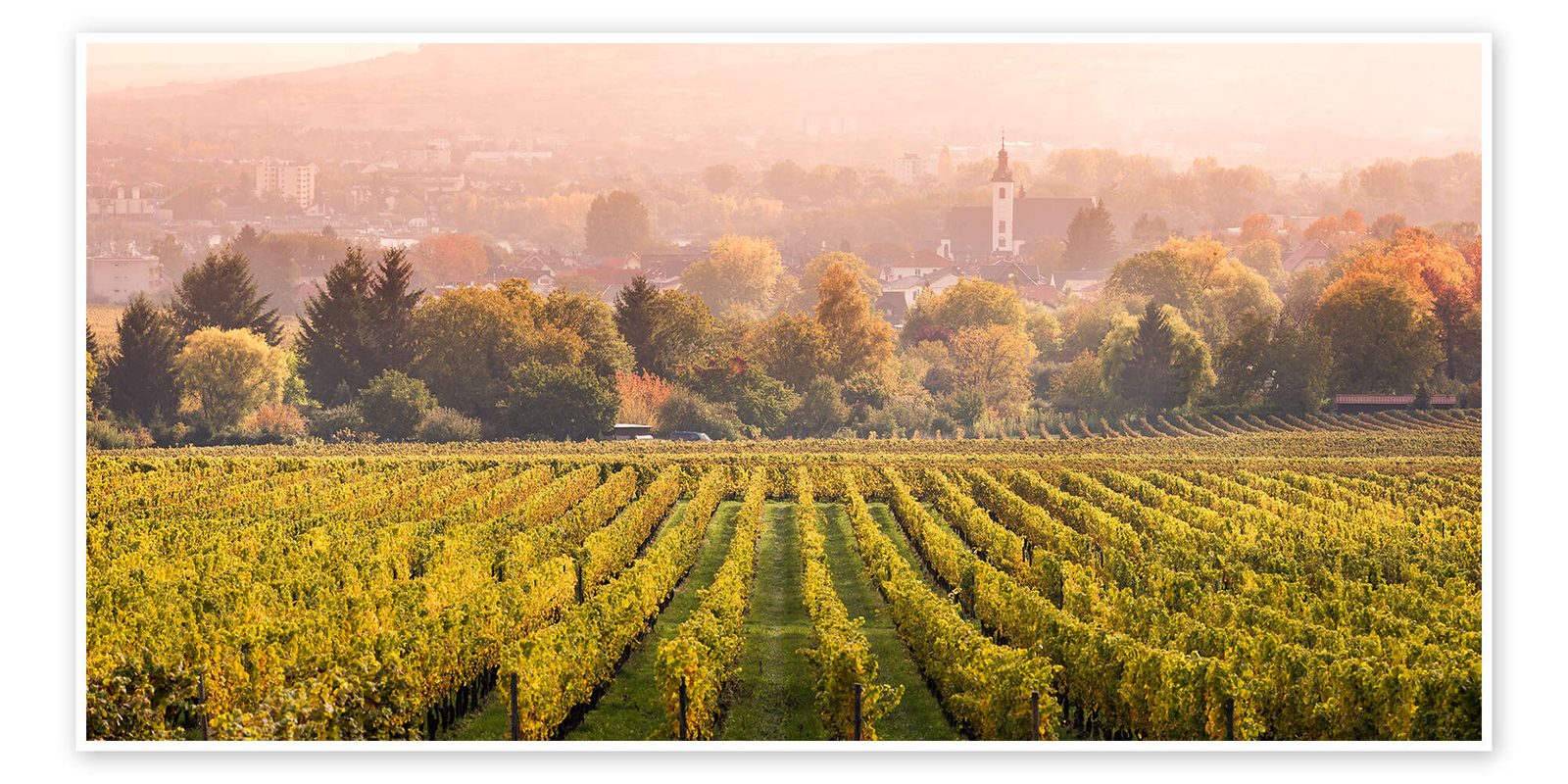
Four days on the one stretch where the Rhine runs east–west, so the whole slope faces south — which is why this modest strip of Hesse produced the wines that made Riesling famous, and why 19th-century Rheingau bottles outsold Bordeaux first growths at auction.
The cycling is easy: the Rhine cycle path runs flat along the water, and the Rheingauer Riesling Route loops up through the vineyards behind. Between them sit an astonishing concentration of names — Schloss Johannisberg, Schloss Vollrads, and Kloster Eberbach, the 12th-century Cistercian monastery whose vaulted cellars stood in for the abbey in the film of *The Name of the Rose*.
A little history
The Cistercians of Kloster Eberbach cleared and planted these slopes from 1136 and shipped wine down the Rhine in their own fleet; by the 18th century the Rheingau's bottles were among Europe's most expensive. Two accidents of history happened here: Spätlese, invented at Schloss Johannisberg in 1775 when the messenger carrying the abbot's permission to pick arrived late and the botrytised grapes turned out to make something extraordinary; and the word 'hock', the English term for German white wine, a corruption of Hochheim, the Rheingau village at the eastern end that Queen Victoria liked enough to have a vineyard named after her.
What it costs
Per person for the whole weekend, priced for a party of four — two twin rooms, or one whole place between you. Everything but the bed is fixed, so where you sleep is the only row that moves and the only one shown as a range.
| Per person | |
|---|---|
| Getting there, both ways | £150 |
| Three nights | £90–140 |
| Bikes and getting about | £44 |
| Eating, drinking and tastings | £165 |
| The weekend, per person | ~£450–500 |
Where to sleep
| Option | Per person |
|---|---|
| Hotels — two twin rooms | |
| Winzerhöfe and guesthouses in Rüdesheim and Oestrich-Winkel | €35 a night £90 for three |
| Hotels along the river at Eltville | €55 a night £140 for three |
No published market data for Rüdesheim. The listings that do show up are large riverside houses at holiday-let prices rather than typical flats, so there is no honest median to quote.
Eating and drinking
| What | Each |
|---|---|
| A Mittagstisch | €8–13 |
| Dinner in a Weinstube with a bottle | €30–50 |
| A glass of Rheingau Riesling | €4–6 |
| Tastings at the Weingüter | €5–15 |
The £165 above assumes the middle of this list: a cheap lunch, an ordinary dinner, one good one over the weekend, and wine throughout. It does not change with the room.
Day by day
Friday Arrive & Eltville
- Late-morning flight; train along the Rhine into Eltville by mid-afternoon.
- Eltville is a rose-growing town with a 14th-century Electors' castle on the water and a Gutenberg connection — he was made a courtier here.
- Late afternoon: a first Riesling by the river, watching the barge traffic.
- Dinner: Rheingau cooking is Rhenish and hearty. Handkäse mit Musik if anyone is brave.
Saturday Along the Rhine, over the Taunus, down to Kiedrich
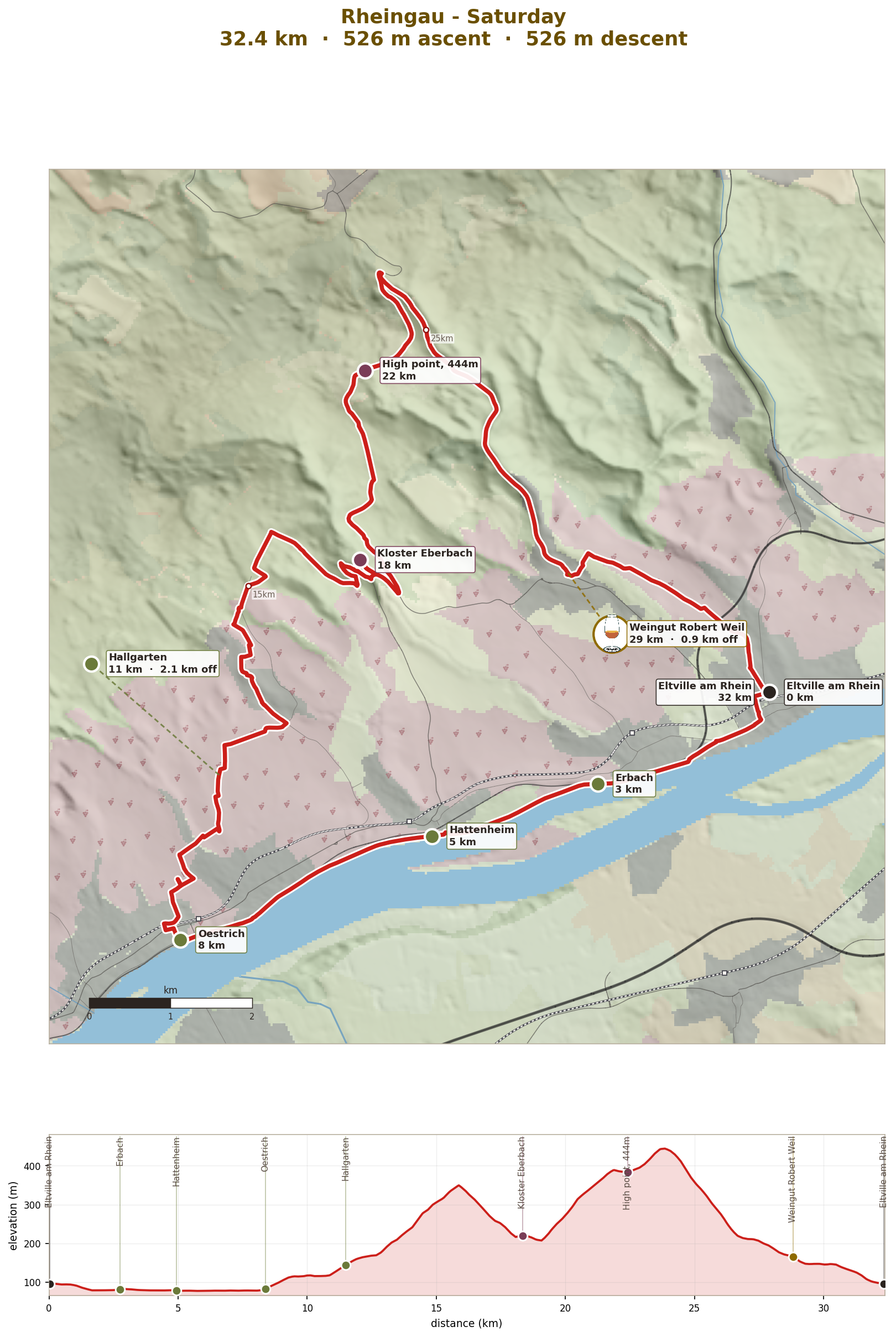
- 32.4km with 526m of ascent, a loop from Eltville, ridden anticlockwise so that the flat comes first and the tasting comes last.
- Eight flat kilometres west along the river to start — Erbach at 3km, Hattenheim at 5km, Oestrich at 8km, where the old wooden loading crane still stands on the bank. Legs warm, nothing asked of them yet.
- Then inland and up. Hallgarten at 12km puts you on the Rheingauer Riesling Route — vineyard lanes with the Rhine dropping away below.
- Kloster Eberbach at 18km, and the reason for the day. Cistercian, founded 1136: a vast bare Romanesque basilica, a monks' dormitory running the length of the building, and thirteen medieval presses in the lay refectory. The cellars stood in for the abbey in The Name of the Rose. Allow two hours.
- Then the sting. The steepest kilometre of the weekend — 7.8% — starts more or less in the monastery car park, and takes you to the high point of 444m at 22km in the wooded Taunus. Cold legs and a glass of Riesling; it is the one genuinely awkward moment in the route, and it is over in fifteen minutes.
- Ten kilometres of descent to finish, 350 metres of it, dropping out of the woods into Kiedrich.
- Weingut Robert Weil at 29km, with two downhill kilometres left to the hotel. The modern benchmark for Rheingau Riesling across the whole sweetness range, and exactly where a tasting belongs. Vinothek Mon–Fri 08.00–17.30, Sat 10.00–17.00, Sun 11.00–17.00; ring ahead for six or more.
32.4 km · 527 m of ascent · 78–444 m
Timing Kloster Eberbach
This needs planning more than any other stop on the site, and the drop-in tour has three catches.
| April–October | November–March | |
|---|---|---|
| Grounds | Mon–Fri 10.00–19.00 Sat, Sun & holidays 09.00–19.00 | Mon–Fri 11.00–18.00 Sat, Sun & holidays 10.00–18.00 |
| Public tours | Fri 15.00 Sat, Sun & holidays 11.00, 13.00, 14.00 | Sat & Sun 14.00 only |
| Vinothek | daily 10.00–19.00 | daily 10.00–18.00 |
| Klosterschänke | Thu–Sat 12.00–22.30, otherwise to 21.30 — closed Tuesdays | |
The catches. The scheduled tours are German-language only — an English tour has to be booked individually and in advance. They take individuals and groups of up to five, thirty people maximum, allocated first come first served at the ticket office. And last admission is always thirty minutes before the ticket office shuts.
Admission is €13, or €9 on a valid RMV or RTV public transport ticket — worth holding onto the ticket that brought you into the Rheingau. A place on the guided tour is €24 including admission. Arriving at 18km on a 32km day — but with the first eight of those flat — the 13.00 tour is the natural target, and the 11.00 is reachable if you leave by half nine and do not linger on the river. Note also that the monastery keeps special hours during the Rheingau Music Festival.
Sunday The two Schloss estates, and the cable car
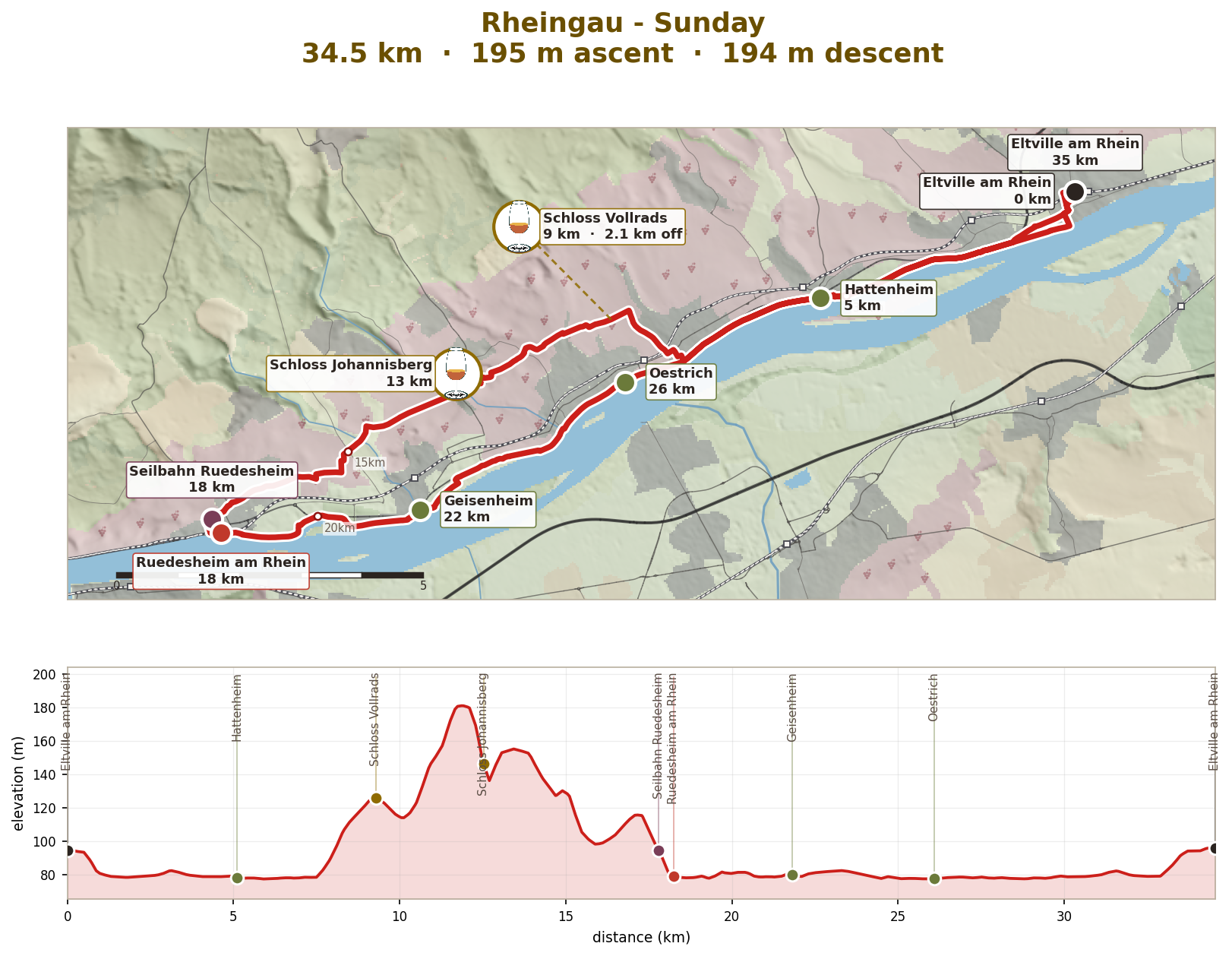
- 34.5km with 195m of ascent — the flat day, west along the Rhine and back, and the one that carries the wine.
- Schloss Vollrads at 9km, two kilometres up off the river. Wine has been sold from here since 1211, which makes it one of the oldest wine estates on earth, and the Vinothek in the old coach house takes walk-ins with no appointment — Sat and Sun 10.00–16.00. That single fact makes it the reliable tasting of the weekend.
- Schloss Johannisberg at 13km, dead on the route. Riesling since 1720, and the place where in 1775 a late-arriving courier delayed the harvest order, the grapes rotted nobly, and Spätlese was invented by accident. The Vinothek is open daily 10.00–18.00 and the Gutsausschank has a terrace over the Rhine — but cellar tours need a coach party of forty and a sit-down tasting needs ten, so for two or four people this is the shop and the view, not a tour.
- Rüdesheim at 18km for lunch and the turn. The Drosselgasse is a tourist alley best walked briskly, but the cable car up over the vines to the Niederwald monument gives the definitive view of the Rhine gorge. It runs from 09.30, to 17.00 in early spring and late autumn and to 18.00 or 19.00 through the summer.
- Flat home on the river path through Geisenheim and Oestrich.
- Why the tastings come early here. Vollrads shuts at 16.00 at weekends, so it cannot be saved for the end of the day. The schedule decides the order, not the terrain — which is the opposite of how the rest of these weekends are built.
34.5 km · 195 m of ascent · 78–181 m
Monday Home
- Morning: the river, or a short train downstream to Assmannshausen, the Rheingau's red-wine village, where Pinot Noir has been grown since the Middle Ages. Do not plan on the chairlift there — the Niederwald-Seilbahn at Assmannshausen closes from 19 May 2026 and is provisionally shut through to November. The Rüdesheim cable car is a different lift and runs normally.
- Train back to Frankfurt Airport — an hour, direct — and the evening flight.
When to go
Spring — March to May
8–19°C. Riesling terraces bare but the Rhine gorge green, castles clear of foliage, and the river path quiet. Changeable — pack for rain.
Summer — June to August
17–27°C, warm and often hazy over the water. The Rheingau Musik Festival puts concerts in monasteries and castles all summer, which is the region at its best.
Autumn — September and October
10–19°C. The Riesling slope turns gold, the Kloster Eberbach cellars fill, and the wine taverns run through October. Mists rise off the river in the mornings.
When to go
September. Warm days, harvest in the vineyards, and the summer concert season not quite finished.
Festivals
None of this weekend assumes a festival. The rides work on any weekend of the season. If your dates land on the Rheingau Musik Festival, the concerts are in Kloster Eberbach and Schloss Vollrads — both on the Sunday route — so ride in the day and come back for the evening. The trade is worth stating plainly: on a festival weekend the growers are behind a stand in the square rather than showing visitors round a cellar, so book private tastings weeks ahead or accept that some will be shut, and expect beds to be scarcer, dearer and gone months in advance.
Spring
Tage der offenen Weinkeller — spring weekends
Open cellar days across the Rheingau villages, when growers who normally work by appointment simply open the doors.
Summer
Rheingau Musik Festival — late June to early September
Concerts in Kloster Eberbach's monastic basilica, in Schloss Johannisberg and in Schloss Vollrads. Worth planning a weekend around.
Rüdesheim and Eltville wine festivals — July and August
Riverside wine weeks with the growers pouring and the Rhine going past.
Autumn
Rheingauer Schlemmerwochen — autumn
Gourmet weeks pairing the region's kitchens with its Riesling, running through the harvest.
Getting there
From London, per person, assuming bikes are hired locally rather than flown. Fares checked September 2026 and converted at €1 to 86p.
| Leg | Time | Cost |
|---|---|---|
| The flight | ||
| BA, Lufthansa or Ryanair to Frankfurt (FRA), many daily | 1h 40 | £65 |
| Airport to the Rhine | ||
| Direct S-Bahn and regional train towards Wiesbaden and along the river to Eltville or Rüdesheim (€12). Frankfurt has a full railway station under the terminal, which makes this one of the easiest arrivals here | 1h 00 | £10 |
| Waiting and one change | 0h 50 | — |
| Door to door, one way | 3h 30 | £75 |
| Both ways | £150 | |
Bike hire
Assumes hybrids.
| Shop | Rate |
|---|---|
| Rheingau Riesling Rad, Oberstr. 42–44, Rüdesheim — the biggest in the region: 200 touring bikes and 60 e-bikes, open 9am to 9pm daily, and it delivers to hotels along the Rheingau | €25 a day e-bike |
| Hotels along the river — a good many keep bikes for guests, which is worth asking before you hire anything | often free |
Getting about
| What | Cost |
|---|---|
| Bike hire, Saturday and Sunday | £30 |
| Regional trains along the Rhine, allow | £10 |
| Rüdesheim–Bingen ferry with a bicycle | £4 |
| Getting about, whole weekend | £44 |
The wineries
Kloster Eberbach
Monastery, medieval presses, vast cellars and a serious modern winery. Tours and tastings daily — the anchor of the trip.
Schloss Johannisberg
The estate that invented Spätlese by accident in 1775, with a terrace looking out over the Rhine. Tastings daily.
Schloss Vollrads
One of the oldest wine estates in the world, in a moated tower with a good restaurant. Receives visitors reliably.
Weingut Robert Weil
Modern benchmark for Rheingau Riesling across the whole sweetness range. Book ahead.
The wines
Riesling, and almost nothing else — around 78% of the plantings — from bone-dry Grosses Gewächs to the noble-sweet Auslese, Beerenauslese and Trockenbeerenauslese the region invented. Spätburgunder (Pinot Noir) at Assmannshausen is the historic exception and much better than its obscurity suggests.
Eat & drink
| Friday | Riverside dinner in Eltville |
| Saturday | Lunch at Kloster Eberbach |
| Sunday | Schloss Vollrads or Rüdesheim |
| Monday | Coffee by the Rhine before the train |
The food
Rhenish and unfussy: Handkäse mit Musik (sour-milk cheese marinated in onions and vinegar), Grüne Sosse, Rippchen mit Kraut, Spundekäs with pretzels, and Federweißer with Zwiebelkuchen in season. Frankfurt's apple wine culture is half an hour east.
Where to stay
Kloster Eberbach guesthouse
Rooms in the monastery grounds — atmospheric, quiet, and you can walk the cloister after the visitors have gone.
Hotel Frankenbach
A comfortable family-run hotel in the middle of town, walking distance from the river and the station.
Rüdesheim
More beds and more restaurants, though also more day-trippers. Good if Eltville is full.
Practical
- Germany is the outlier: 1.6 g/l before a cyclist is automatically unfit, but 0.3 g/l is enough to be prosecuted if you ride badly or come off. A conviction on a bicycle can cost you your car licence. See the country-by-country table.
- Easiest arrival of the German options — Frankfurt Airport has a railway station under the terminal and the train runs straight to the Rheingau in an hour.
- Kloster Eberbach deserves half a day, not an hour. Monastery, presses, cellars and tasting.
- The Rhine Gorge starts just downstream at Rüdesheim — the castle-lined UNESCO stretch — if anyone wants a boat trip on the Monday.
- Bike hire in Eltville and Rüdesheim, e-bikes included; the Rhine path is flat and the vineyard route only gently graded.
- Check sunset before you plan the last leg. Any day that finishes with a ride home wants an hour of light in hand, and that hour disappears fast either side of the equinoxes.
- Rheingau Tourism — official regional tourist board — routes, estates, events
- Kloster Eberbach — the monastery, its wines and visitor programme
- German Wine Institute — Rheingau — the official body for German wine regions
- Rüdesheim cycling — local route information along the Rhine