The weekend
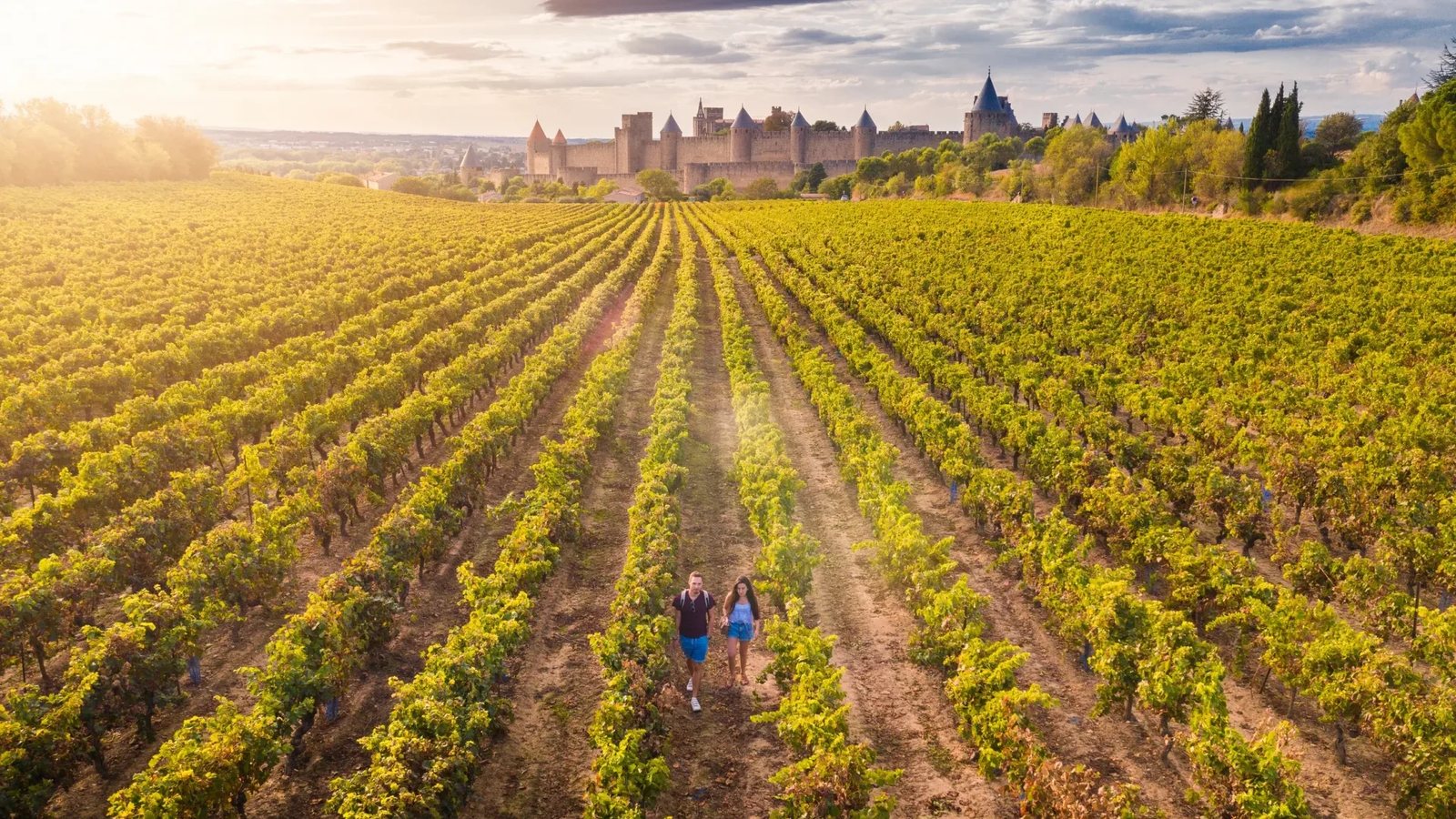
If the object is riding that absolutely anyone can do, this is the answer. The Canal du Midi runs 240 kilometres from Toulouse to the Mediterranean without a single hill: Pierre-Paul Riquet's 17th-century masterpiece, a UNESCO site since 1996, with a towpath along the whole of it and vineyards on both banks.
Carcassonne makes the base — the airport is ten minutes from the middle of town, the station is on the canal, and the Cité on the hill above is the largest walled city in Europe. You ride out along the water, taste in the wine villages that grew up around the canal ports, and come back by train.
Two honest caveats before you fall in love with the photographs. The famous tunnel of plane trees is going: a fungus called chancre coloré, introduced in American ammunition crates in 1944, has forced the felling of tens of thousands of trees since 2006. Replanting is well under way, but long stretches are now saplings or open sky. And the towpath surface is variable — smooth new greenway in places, rough gravel and tree roots in others. Hybrids or gravel bikes, not road bikes.
A little history
Riquet's canal was the great engineering project of Louis XIV's France: begun in 1666, finished in 1681, dug by a workforce of twelve thousand that included large numbers of women, and paid for substantially out of Riquet's own fortune — he died months before it opened, deep in debt. It required the first canal tunnel in Europe at Malpas and a staircase of locks at Fonseranes, and it solved a problem the Romans had given up on. Carcassonne is older and bloodier: a Roman hill fort, then a Cathar stronghold that fell to Simon de Montfort's crusade in 1209, then a frontier fortress made redundant overnight when the border moved south in 1659. The Aude's other history is wine and anger — the region's vast 19th-century vineyard boom collapsed into the winegrowers' revolt of 1907, when hundreds of thousands marched in Narbonne and Montpellier and the army was sent in.
What it costs
Per person for the whole weekend, priced for a party of four — two twin rooms, or one whole place between you. Everything but the bed is fixed, so where you sleep is the only row that moves and the only one shown as a range.
| Per person | |
|---|---|
| Getting there, both ways | £112 |
| Three nights | £55–135 |
| Bikes and getting about | £38 |
| Eating, drinking and tastings | £160 |
| The weekend, per person | ~£360–440 |
Where to sleep
| Option | Per person |
|---|---|
| Hotels — two twin rooms | |
| Two-star hotels in the lower town | €22 a night £60 for three |
| Hotels and chambres d’hôtes near the canal | €52 a night £135 for three |
| Airbnb and self-catering — one whole place | |
| The Carcassonne average for a whole place — 1,250 active listings | €21 a night £55 for three |
A big, competitive market, which is why it is the cheapest self-catering on the site after Saumur.
Eating and drinking
| What | Each |
|---|---|
| A menu du jour | €15–22 |
| Cassoulet, properly made | €15–20 |
| Dinner with a bottle of Minervois | €35–55 |
| Tastings in the Minervois | free to €10 |
The £160 above assumes the middle of this list: a cheap lunch, an ordinary dinner, one good one over the weekend, and wine throughout. It does not change with the room.
Day by day
Friday Arrive & the Cité
- Ten minutes from plane to hotel — the shortest transfer of any flight-based option here.
- Up to La Cité for the afternoon: 52 towers, a double ring of walls, and a restoration by Viollet-le-Duc in the 1850s that historians have been arguing about ever since. Go late in the day, when the coach parties have gone and the walls turn gold.
- Cassoulet for dinner, and the first of several unwinnable arguments about whose version is correct — Carcassonne's has lamb in it, which Castelnaudary considers heresy.
Saturday Down the canal to Homps, then south to the train
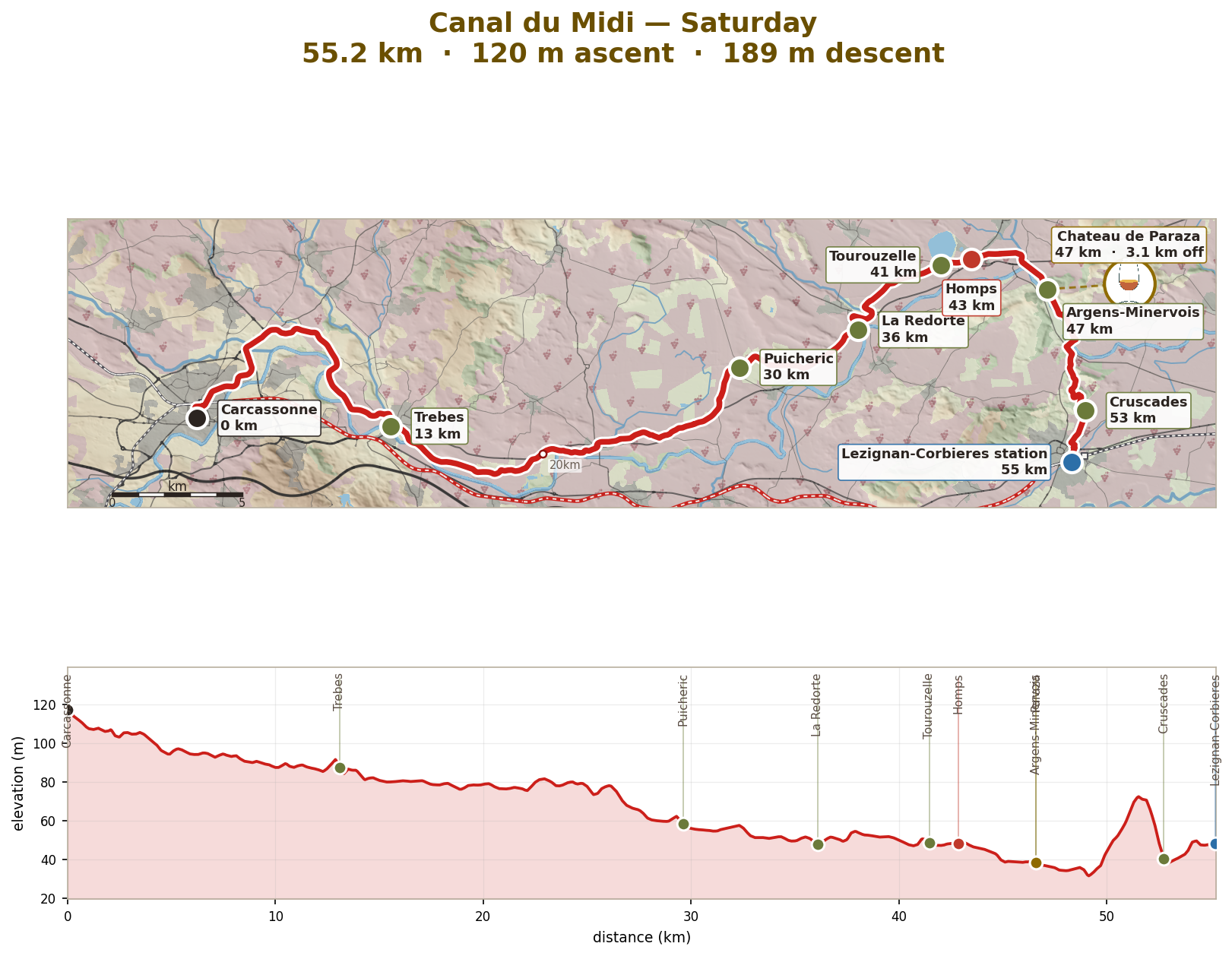
- 55.2km with 120m of ascent, one way, finishing at Lézignan-Corbières station — twenty minutes back to Carcassonne on the TER. About as flat as a day's riding gets.
- Trèbes at 13km, where the canal crosses two rivers on aqueducts and the port is lined with cafés.
- The middle stretch runs inland on quiet roads south of the Aude rather than on the towpath — the surface west of Homps is unsurfaced in long sections, and the roads are the faster, drier answer. Back beside the water at Puichéric, 30km.
- La Redorte at 36km, then Tourouzelle, and into Homps at 43km — the old wine-shipping port, and lunch. The Minervois growers keep a tasting room on the quay, which makes this the wine stop of the day as well as the food one.
- Argens-Minervois at 47km, castle above the canal, where the route turns south for Lézignan.
- Château de Paraza sits 3km east along the water from that turn — Pierre-Paul Riquet lodged there while the canal was being dug, and the terrace looks straight down onto it. A six-kilometre out-and-back on the flat if you want a second cellar; Domaine Ventenac is a further 3km on again.
- Down through Cruscades at 53km and into Lézignan-Corbières for the train.
55.2 km · 120 m of ascent · 32–117 m
Sunday Over the Malepère to Limoux
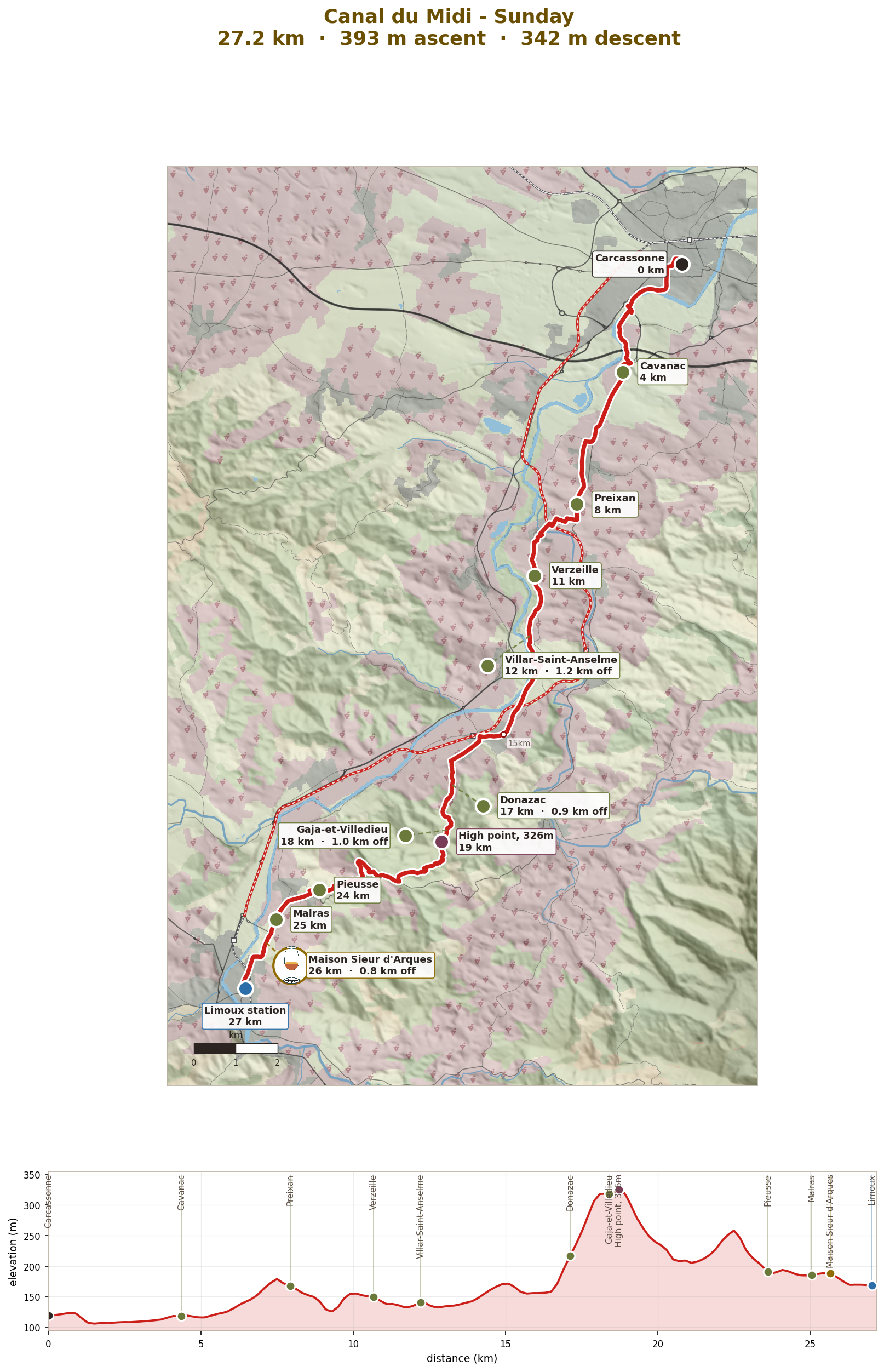
- 27.2km with 393m of ascent, one way, ending at Limoux station — short, and by some distance the hilliest thing in this weekend. Ride it southbound and let the train bring you back.
- Flat for the first twelve kilometres up the Aude valley through Cavanac at 4km, Preixan at 8km and Verzeille at 11km.
- Then the Malepère. From 16km the road climbs 200m in four kilometres to a col at 326m, past Donazac. It is the only real climb of the weekend and it comes on the day that looks easiest on paper.
- Over the top at Gaja-et-Villedieu, 18km, and everything after it is downhill into the Limoux valley.
- Pieusse at 24km, where the Blanquette appellation was first delimited, then Malras.
- Maison Sieur d'Arques at 26km, on the edge of town: the Limoux co-operative, walk-in tasting across the whole range, and the right end of the day for it. Blanquette de Limoux has a decent claim to being the oldest sparkling wine in the world — the monks of Saint-Hilaire were making it from 1531, a century before Champagne.
- Limoux at 27km, and the arcaded Place de la République for a long Sunday lunch. Antech, at Domaine de Flassian a couple of kilometres south of the station, is the family alternative to the co-operative if you want a second and more serious tasting.
- Train back to Carcassonne, 40 minutes. Sunday services on this line are thin — check the timetable before you set off rather than after lunch.
27.2 km · 393 m of ascent · 106–326 m
The flat alternative
If the Malepère is more than the legs want on a Sunday, take the train down to Limoux and ride the valley instead — or stay north of Carcassonne for a flat 25km loop out to Château de Pennautier, the ‘Versailles of the Languedoc’, built by a treasurer of the Estates and still in the same family after four centuries. Cabardès is the only French appellation that blends Atlantic and Mediterranean varieties, which is worth tasting side by side. Either way, back into Carcassonne for the evening — the lower town, the Bastide Saint-Louis, is where people actually eat.
Monday Narbonne, then home
- Train to Narbonne, half an hour, for Les Halles — a cast-iron covered market from 1901 that is among the best food halls in France, and where lunch is a matter of pointing.
- If there is time, the Abbaye de Fontfroide sits in the Corbières hills outside Narbonne: a 12th-century Cistercian abbey with cloisters, rose gardens and its own vineyard.
- Back to Carcassonne and the ten-minute run to the airport.
When to go
Spring — March to May
9–20°C, green and fresh, with the canal full and the plane trees coming into leaf. The Cers wind blows through; Carcassonne is at its quietest.
Summer — June to August
18–31°C. Hot and dry, with the towpath shade doing real work. The Festival de Carcassonne fills July, and the 14 July Embrasement sets the fortress apparently ablaze.
Autumn — September and October
11–22°C, warm into October, the harvest done, and the villages back to themselves. Comfortably the best riding weather of the year.
When to go
September or October for the riding and the quiet; July if the Carcassonne festival and the fireworks appeal.
Festivals
None of this weekend assumes a festival. The rides work on any weekend of the year. If your dates land on Toques et Clochers at Limoux on Palm Sunday, that is the day to go to Limoux rather than ride; the towpath keeps perfectly well until the Monday. The trade is worth stating plainly: on a festival weekend the growers are behind a stand in the square rather than showing visitors round a cellar, so book private tastings weeks ahead or accept that some will be shut, and expect beds to be scarcer, dearer and gone months in advance.
Spring
Carnaval de Limoux — January to March
Claimed as the longest carnival in the world: masked bands parading in the square every weekend for three months, and Blanquette poured throughout.
Toques et Clochers, Limoux — Palm Sunday weekend
The Languedoc's great wine event — a village auction with chefs cooking in the streets, raising money to restore church bell towers.
Summer
Festival de Carcassonne — July
Concerts and theatre inside the walls, and on 14 July the Embrasement de la Cité, when the whole fortress is lit as though it is burning.
Autumn
Village harvest festivals — September
Minervois and Corbières villages each run their own, set locally and late. Ask when you arrive.
Getting there
From London, per person, assuming bikes are hired locally rather than flown. Fares checked September 2026 and converted at €1 to 86p.
| Leg | Time | Cost |
|---|---|---|
| The flight | ||
| Ryanair, Stansted to Carcassonne (CCF). Daily through the season, April to late October — check the schedule outside it | 2h 00 | £50 |
| Airport into town | ||
| Carcassonne airport is 3km out — a ten-minute taxi at €20 for the car, or the shuttle bus | 0h 10 | £6 |
| Waiting, and not much of it — this is the shortest arrival on the site | 0h 40 | — |
| Door to door, one way | 2h 50 | £56 |
| Both ways | £112 | |
Toulouse flies daily year-round from Gatwick, Heathrow and Stansted, and the train to Carcassonne takes 45 to 55 minutes. Slightly longer, and immune to seasonal schedule changes.
Bike hire
Assumes hybrids — the towpath is packed gravel, not tarmac.
| Shop | Rate |
|---|---|
| Le Petit Cyclo — 300m from the station and right on the canal, which is about as convenient as hire gets | €15–25 a day |
| Easy Vélo — delivers hybrids or e-bikes to the hotel | €15–25 a day |
Less than half what Switzerland charges.
Getting about
| What | Cost |
|---|---|
| Bike hire, Saturday and Sunday | £30 |
| TER along the canal, allow | £8 |
| Getting about, whole weekend | £38 |
The wineries
Château de Paraza
A handsome estate directly above the water, where Pierre-Paul Riquet stayed while supervising the digging. Minervois reds, a terrace over the canal, and visits without ceremony.
Domaine Ventenac
Right on the towpath, which makes it the easiest possible stop mid-ride. Minervois and Cabardès from the same family, and an unfussy welcome.
Château de Pennautier
A 17th-century château with formal gardens, still in the founding family after four centuries, making Cabardès from both sides of the watershed. Tours and tastings run to a schedule.
Abbaye de Fontfroide
One of the great abbeys of the south: cloisters, rose gardens, a 12th-century church, and a working vineyard. Worth the taxi from Narbonne even without the wine.
Domaines in La Livinière
The Minervois cru, 15km off the towpath and uphill. Better wine, more effort; a taxi or a determined afternoon.
The wines
Big, warm, well-priced southern reds, and far better than their reputation. Minervois blends Syrah, Grenache and old-vine Carignan, with La Livinière as its cru; Corbières is wilder and more herbal, with Boutenac at the top; Cabardès, in the hills just north of Carcassonne, is the only French appellation that blends Atlantic varieties with Mediterranean ones — Cabernet and Merlot alongside Syrah and Grenache — because it sits exactly on the watershed. And Limoux makes both Blanquette and some of the best-value traditional-method sparkling in France.
Eat & drink
| Friday | Cassoulet in the Bastide Saint-Louis, Carcassonne |
| Saturday | Lunch on the quay at Homps, among the barges |
| Sunday | Limoux, with a bottle of Blanquette that costs a third of Champagne |
| Monday | Les Halles in Narbonne — point, sit down, eat |
The food
Cassoulet, obviously — white beans, confit duck, Toulouse sausage, and a crust broken back into the dish seven times if you believe the purists. Beyond that: fricassée and daube, oysters from the Étang de Leucate and Gruissan, brandade of salt cod, Pélardon goat cheeses, and whatever is on the slab at Les Halles in Narbonne. Prices are noticeably lower than anywhere else on this list.
Where to stay
Hôtel de la Cité
The grand option, literally within the fortress, with a garden looking over the ramparts. Expensive, and the only way to have the Cité to yourself after closing time.
Hôtel du Pont Vieux
Good value, ten minutes' walk from both the fortress and the canal, with a roof terrace facing the walls.
Canal-side at Trèbes or Homps
If the group would rather wake up on the towpath than in town — smaller, simpler, and it shortens the Saturday ride considerably.
Practical
- France allows cyclists 0.5 g/l of blood alcohol, the same limit as drivers — so one glass with lunch is the practical ceiling if you are riding afterwards. See the country-by-country table.
- Check the flight season before anything else. Stansted–Carcassonne is a daily summer-season route running roughly April to late October, and the timetable turns over in the last week of October, so a late-October weekend is the last one that works and anything into November is not. In spring and summer it runs daily. Toulouse plus a 45-minute train is the year-round fallback.
- Hybrids, not road bikes. The towpath alternates between smooth greenway and rough roots-and-gravel. Wide tyres make the difference between a lovely day and a rattled one.
- The plane trees are patchy. Disease has taken tens of thousands of them; some stretches are magnificent, others are open and replanted. Worth knowing so nobody is disappointed.
- The train is the bail-out. The Carcassonne–Narbonne line shadows the canal, so any ride can end at a station — Lézignan-Corbières is the usual one.
- One of the four cheapest weekends here, and cheap for the right reasons rather than by cutting anything out. Flights, hotels, bike hire and dinner are all noticeably less than the Alpine and Swiss options.
- Go up to the Cité late. By six o'clock the day-trippers have gone and it is a different place entirely.
- Canal des 2 Mers à Vélo — the official route site — stage by stage, with surface conditions
- Grand Carcassonne Tourisme — the local tourist board on cycling the canal, and bike hire listings
- Carcassonne Airport — the Stansted route, with the current seasonal schedule
- Minervois wines — the appellation site — producers, villages and La Livinière
- Abbaye de Fontfroide — visiting the abbey and its vineyard