The weekend
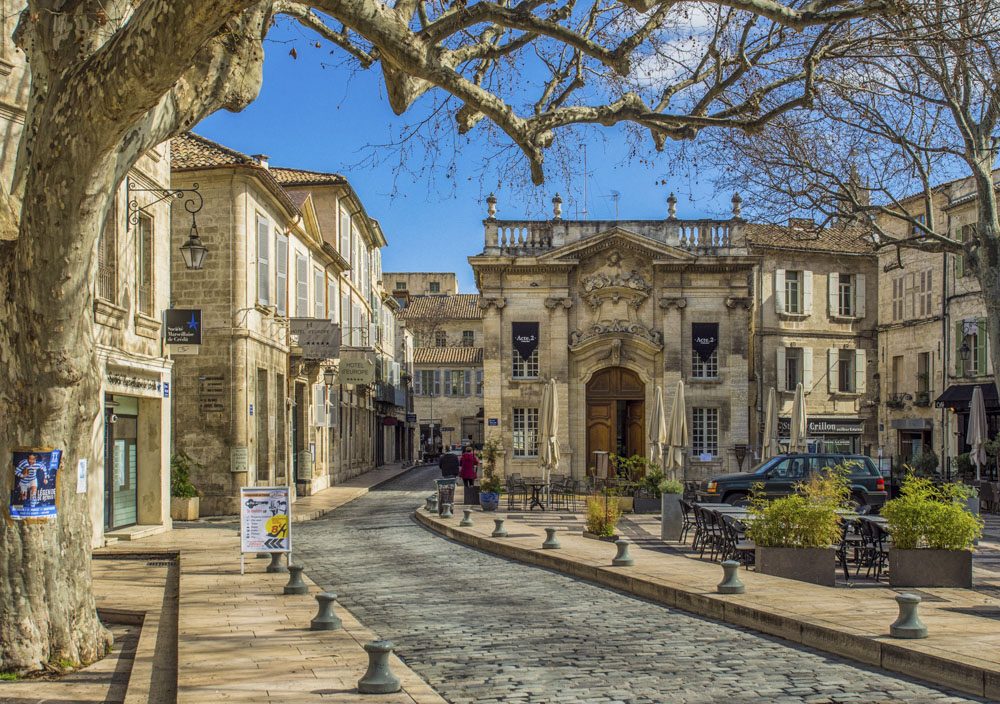
Four days based in Avignon, which is the argument for it: unlike most of the destinations here, this is a proper city — the Palais des Papes, the famous half-bridge, a walled old town, a covered market and a serious restaurant scene. A wet afternoon here is no disaster, which cannot be said of a village of four hundred people.
The cycling is flat along the Rhône on the ViaRhôna, with the single climb of the weekend being the ramp up into Châteauneuf-du-Pape itself. The village is unusually welcoming for France: a dozen tasting rooms take walk-ins, and Vinadea pours a rotating cast of ninety-odd producers under one roof — which removes the entire booking problem at a stroke.
A little history
For sixty-eight years in the 14th century, Avignon rather than Rome was the seat of the papacy — seven French popes ruled from the fortress-palace that still dominates the city, and the city stayed papal territory until the French Revolution. Châteauneuf-du-Pape takes its name from the summer castle that Pope John XXII built in the vineyards; the popes' thirst is the reason the vineyards exist at all. In 1923 the growers of Châteauneuf wrote the rules that became France's entire appellation contrôlée system — the first attempt anywhere to define a wine by its place in law.
What it costs
Per person for the whole weekend, priced for a party of four — two twin rooms, or one whole place between you. Everything but the bed is fixed, so where you sleep is the only row that moves and the only one shown as a range.
| Per person | |
|---|---|
| Getting there, both ways | £172 |
| Three nights | £70–140 |
| Bikes and getting about | £36 |
| Eating, drinking and tastings | £180 |
| The weekend, per person | ~£460–530 |
Where to sleep
| Option | Per person |
|---|---|
| Hotels — two twin rooms | |
| Hostels and small hotels inside the walls | €30 a night £75 for three |
| Three-star hotels near the Palais des Papes | €55 a night £140 for three |
| Airbnb and self-catering — one whole place | |
| The typical Avignon listing | €28 a night £70 for three |
Eating and drinking
| What | Each |
|---|---|
| A menu du jour | €16–28 |
| Dinner in Avignon with a bottle | €40–70 |
| Tastings at Châteauneuf | €10–25 |
The £180 above assumes the middle of this list: a cheap lunch, an ordinary dinner, one good one over the weekend, and wine throughout. It does not change with the room.
Day by day
Friday Arrive & the Palais des Papes
- Morning flight to Marseille; TGV north to Avignon by mid-afternoon. Check in inside the walls.
- The Palais des Papes — the largest Gothic palace in Europe, built when seven popes ruled Christendom from Avignon rather than Rome. Vast, echoing and slightly sinister.
- Aperitif on the Place de l'Horloge, then dinner. Provençal cooking, and a first bottle of Châteauneuf.
Saturday Beaumes-de-Venise, Vieux Télégraphe, Châteauneuf
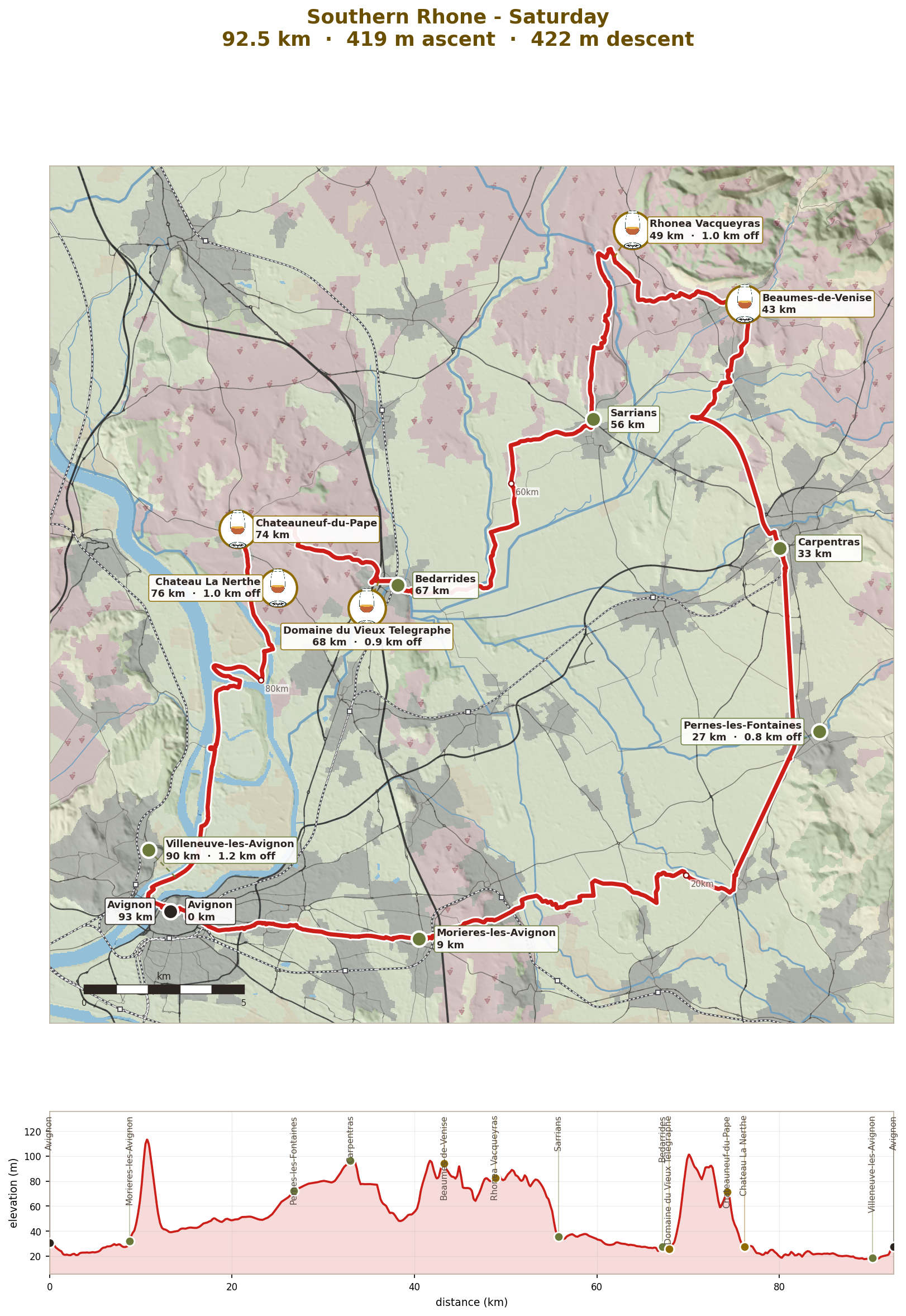
- 92.5km with 419m of ascent, a loop from Avignon, and the big day. Two appellations and four cellars, with the climbing spread thin — nothing on it is steep.
- East across the Comtat plain through Morières at 9km, flat and quick.
- Pernes-les-Fontaines at 27km: forty fountains, a fortified gate and a covered market, and the prettiest thing on the outbound half.
- Carpentras at 33km, and on the railway — the natural bail-out if the legs have gone. If you land here on a Friday, the market is one of the great ones in Provence.
- Beaumes-de-Venise at 43km, half way, under the Dentelles de Montmirail — limestone teeth standing on end above the vines. Famous for its Muscat, a vin doux naturel poured cold as an aperitif rather than a pudding wine, though the reds have got serious over the last twenty years. Vacqueyras is a cru in its own right since 1990, and its cellar is closer to the route than the village is.
- Rhonéa Vacqueyras at 49km, on the route de Vaison and less than a kilometre off the line. A cellar visit and a tasting of four cuvées runs about €10 a head — though the guided tour needs a minimum of eight people, so a smaller party tastes in the shop instead, which is no hardship. The same co-operative has a second cellar back at Beaumes, so you can taste the two appellations six kilometres apart and compare them properly.
- Mind the lunch closure. Outside July and August Rhonéa shuts 12.30–14.00, and on a nine o'clock start you will arrive somewhere around noon — comfortable, but not if you have lingered at Beaumes. In July and August it stays open 10.00–19.00 straight through and the problem disappears.
- West across the plain through Sarrians at 56km to Bédarrides at 67km, where the Ouvèze meets the Rhône.
- Domaine du Vieux Télégraphe at 68km, up on the La Crau plateau where the galets roulés lie deepest. Founded 1898, and one of the appellation's benchmarks — book ahead.
- Châteauneuf-du-Pape at 74km: the village, the ruined papal keep on the crest, and Vinadea, which pours ninety producers under one roof, walk-in, no appointment. Then Château La Nerthe at 76km — oldest estate in the appellation, records from 1560, booked visits only — on the way out.
- Down the river and back over at Villeneuve, 90km, into Avignon at 92km.
- Five cellars, running from 47% to 82% of the day. The empty half is the half you ride fresh, and everything after Bédarrides is a tasting.
92.5 km · 419 m of ascent · 18–113 m
A shorter Saturday, or a different one
Carpentras at 33km is on the railway, so the day divides cleanly: ride out and take the train back for 33km, or train out and ride home for 59km with every cellar still on it. The bail-out is real rather than theoretical.
The other option ignores the Vaucluse entirely and crosses the river instead, to Signargues — the Côtes du Rhône Villages cru covering Rochefort-du-Gard, Saze, Domazan and Estézargues, 46km round. The draw is the Vignerons d’Estézargues: no added yeast for more than thirty years, four fifths of the plots organic, and a separate bottling for each grower rather than one blended house wine. It has to be the Saturday — they open 9–12 and 14–18 on a Saturday and close on Sundays and public holidays, which is normal for the region and the reason this cannot simply swap days.
Sunday First train to Bollène, fifty flat kilometres home to lunch
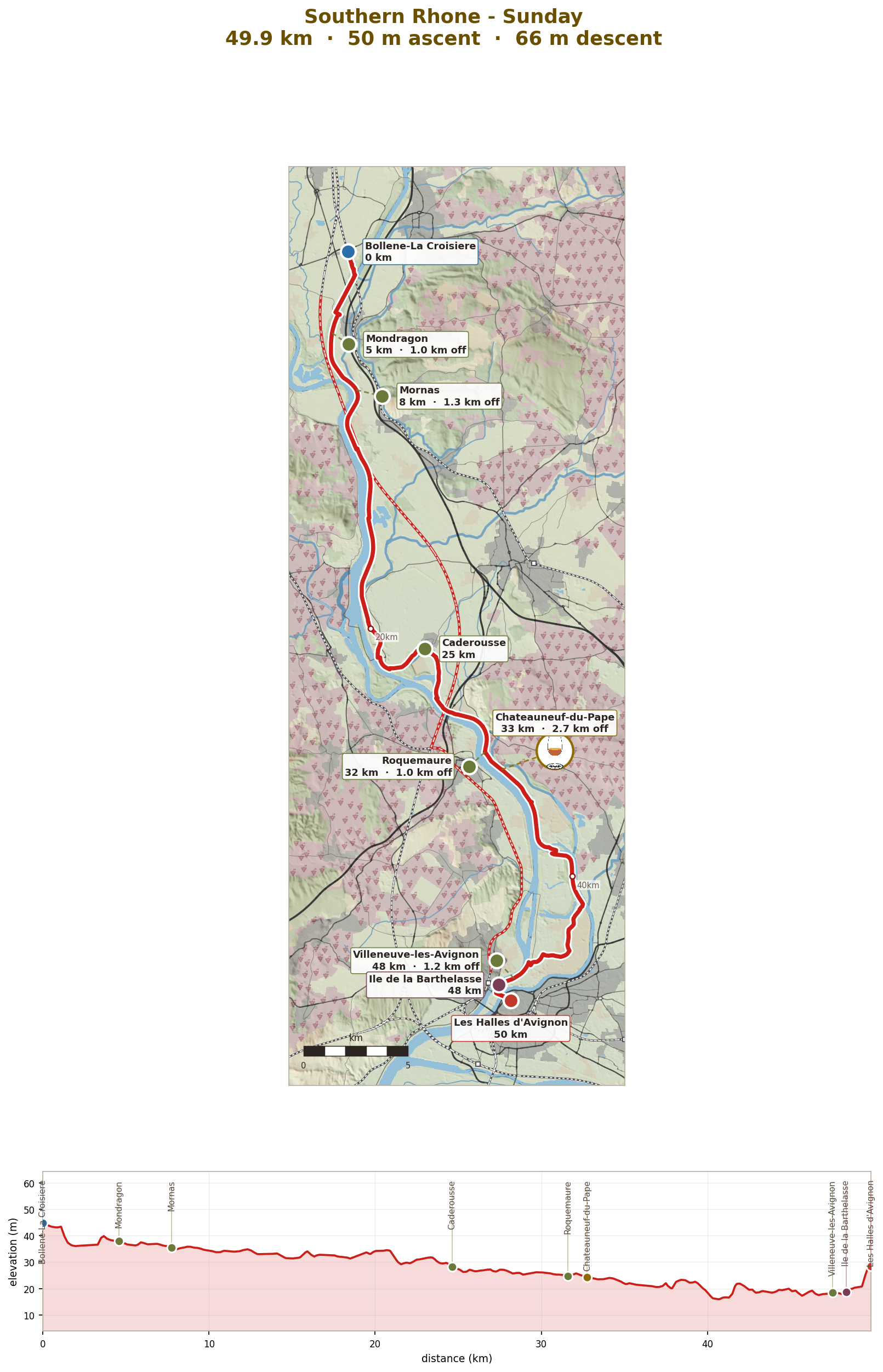
- 49.9km with 50m of ascent, one way, downstream. The highest point of the entire day is 45m, and it is the station you start from. Take the 08.10 out to Bollène, about forty minutes, and ride back.
- Mondragon at 5km under its castle ruin, then Mornas at 8km, where the fortress hangs off a cliff directly above the road.
- Caderousse at 25km is the oddity of the weekend: a village completely ringed by a flood dyke built in 1856, the only one on the Rhône still walled against its own river. You ride in through a gap in the wall.
- Roquemaure at 32km, where the relics of Saint Valentine were brought from Rome in 1868 and are still paraded each February. Lirac and Tavel are the hills behind it.
- Past Villeneuve at 48km with the Chartreuse and Fort Saint-André above you, over the Barthelasse for the classic view of the Palais, and into the city.
- Les Halles by around 12.15 at a steady pace — oysters, charcuterie and a glass at the counter. It is open until 14.00 on a Sunday and the traders pack down before that, so this is a day to keep the stops brief and eat properly at the end of it.
- Afternoon free: the Palais des Papes, the Pont Saint-Bénézet, or the Chartreuse if you rode past it wanting to stop.
49.9 km · 50 m of ascent · 16–45 m
Monday Home
- Morning in the old town — the market again, or the ramparts.
- TGV to Marseille; evening flight to Gatwick.
When to go
Spring — March to May
10–21°C, bright and windy, with the Rhône plain green and the Dentelles sharp against the sky. The mistral blows hardest in spring — check the forecast before planning a long day.
Summer — June to August
19–33°C. Hot, dry and brilliant, and Avignon fills for its theatre festival in July. Riding needs to happen before eleven; afternoons are for cellars and shade.
Autumn — September and October
12–22°C. September is the sweet spot — the heat breaks, the harvest comes in, and Châteauneuf is at its most welcoming.
When to go
September, or May before the heat. July only if the Festival d'Avignon is the point of the trip.
Festivals
None of this weekend assumes a festival. The rides work on any weekend of the season. If your dates land on the Fête de la Véraison at Châteauneuf on the first weekend of August, ride out to the village and stay for it rather than looping back. Avoid the Festival d’Avignon in July unless you want it: the city is full and the prices go with it. The trade is worth stating plainly: on a festival weekend the growers are behind a stand in the square rather than showing visitors round a cellar, so book private tastings weeks ahead or accept that some will be shut, and expect beds to be scarcer, dearer and gone months in advance.
Spring
Printemps de Châteauneuf — spring
The village's growers open together in the spring, a quieter counterpart to the August festivities.
Summer
Festival d'Avignon — July
One of the world's great theatre festivals takes over the papal city for three weeks. Book accommodation months ahead or avoid the dates entirely.
Fête de la Véraison, Châteauneuf-du-Pape — first weekend of August
The whole village dresses medieval for three days as the grapes change colour, with the growers pouring in the streets.
Autumn
Ban des Vendanges and harvest — September
The formal opening of the picking, and the month when the cellars are working and the tastings are at their most interesting.
Getting there
From London, per person, assuming bikes are hired locally rather than flown. Fares checked September 2026 and converted at €1 to 86p.
| Leg | Time | Cost |
|---|---|---|
| The flight | ||
| easyJet, Gatwick to Marseille (MRS) | 2h 10 | £55 |
| Airport to the station | ||
| Airport shuttle to Marseille Saint-Charles (€10) | 0h 30 | £9 |
| Up to Avignon | ||
| TGV, and quicker than you expect | 0h 35 | £22 |
| Waiting and one change | 1h 05 | — |
| Door to door, one way | 4h 20 | £86 |
| Both ways | £172 | |
Flying to Lyon and taking the TGV south is often cheaper, and a lovely run down the river.
Bike hire
Assumes hybrids.
| Shop | Rate |
|---|---|
| South Spirit Bike, Avignon — hybrids, city, gravel and electric, with helmet, lock, repair kit and panniers if you want them. Seven days a week, April to October | €15–40 a day |
| Vélopop’ — Avignon’s own street-corner scheme, fine for getting about town but not for a day in the vines | from €10 a day |
Getting about
| What | Cost |
|---|---|
| Bike hire, Saturday and Sunday | £26 |
| TER to Orange and Carpentras, allow | £10 |
| Getting about, whole weekend | £36 |
The wineries
Beaumes-de-Venise
Best known for Muscat de Beaumes-de-Venise, a vin doux naturel that is poured cold as an aperitif here rather than kept back for pudding — and the reds, promoted to their own cru in 2005, have become serious. Several growers pour in the village; the co-operative is the simplest walk-in. Vacqueyras sits two kilometres off the line just past it.
Rhonéa Vacqueyras
Cellar visit and a tasting of four cuvées for about €10, with a second Rhonéa cellar back at Beaumes-de-Venise six kilometres away — which makes tasting Vacqueyras and Beaumes side by side unusually easy. The guided tour has a minimum of eight people; below that, taste in the shop. Closed 12.30–14.00 except in July and August, and closed Sundays from January to March.
Vinadea
The Maison des Vins: around ninety Châteauneuf producers pouring under one roof, walk-in, no appointment. The efficient answer for a group with one afternoon.
Domaine du Vieux Télégraphe
One of the appellation's benchmark estates, on the La Crau plateau where the pebbles are deepest. Book ahead.
Château La Nerthe
The oldest estate in the appellation, with a handsome château and vaulted cellars. Booked visits.
Domaine de la Janasse
Aimé and Isabelle Sabon's estate, a modern star of the appellation. The Saturday now runs south of it through Bédarrides, so this one is a detour rather than a stop.
The wines
Châteauneuf-du-Pape is a blend — up to thirteen permitted varieties, led by Grenache with Syrah and Mourvèdre — grown on those extraordinary rolled pebbles that store the day's heat and release it overnight. The results are rich, spicy and routinely 14.5–15.5% alcohol. Around it: Gigondas, Vacqueyras, Rasteau, and the rosés of Tavel and Lirac just across the river.
Eat & drink
| Friday | Dinner on the Place de l'Horloge |
| Saturday | Lunch in Châteauneuf village square |
| Sunday | Oysters and charcuterie at Les Halles; Provençal dinner |
| Monday | Market coffee before the TGV |
The food
Provençal — daube of beef with olives, tapenade, brandade, ratatouille done properly, goat cheeses, olive oil from the Alpilles, and melon and figs at the end of their season. Les Halles d'Avignon is one of the best covered markets in France.
Where to stay
La Mirande
A 17th-century cardinal's palace with a famous kitchen and a table in the old cellar.
Hôtel d'Europe
Where Napoleon stayed. Grand, shaded courtyard, a short walk from everything.
Le Vieux Moulin
If you would rather wake in the vines than the city — small, simple, and right by the tasting rooms.
Practical
- Check the bike rules when you buy the train ticket. Avignon is in Provence, but the Rhône valley line north is also worked by TER Auvergne-Rhône-Alpes services, and those require a booked €1 bike space at weekends from May to late September — booked at aura.ter.veloabord.fr, not with the ticket. The applicable rule shows at the point of purchase; if a reservation is offered, take it, because without one you can be refused boarding. This matters for the Sunday, which starts with a train out to Bollène.
- France allows cyclists 0.5 g/l of blood alcohol, the same limit as drivers — so one glass with lunch is the practical ceiling if you are riding afterwards. See the country-by-country table.
- Best non-wine content on the list. Avignon is a real city with a UNESCO palace, so a rained-off afternoon is entertainment rather than disaster.
- Vinadea solves the booking problem — ninety producers, walk-in, no appointment needed. Unusual and very useful in France.
- Mind the alcohol. Châteauneuf is routinely 15%. Twenty kilometres home into a mistral after a long tasting is a genuine consideration — plan the tasting for after the ride, not before.
- Bike hire: plentiful in Avignon, including e-bikes and delivery to the hotel.
- Check sunset before you plan the last leg. Any day that finishes with a ride home wants an hour of light in hand, and that hour disappears fast either side of the equinoxes.
- Avignon Tourism — official tourist office — the palace, the bridge, events
- Châteauneuf-du-Pape official site — the appellation, its producers and visiting information
- Vinadea — Maison des Vins — ninety producers under one roof in the village
- ViaRhôna — official route — the riverside cycle path to the village