The weekend
The easiest weekend on the whole list to actually get to. Barcelona has more flights from London than any other city in Europe, and from Barcelona Sants a suburban train runs out to Sant Sadurní d'Anoia in 45 minutes and Vilafranca del Penedès in an hour — through the vineyards, for the price of a coffee.
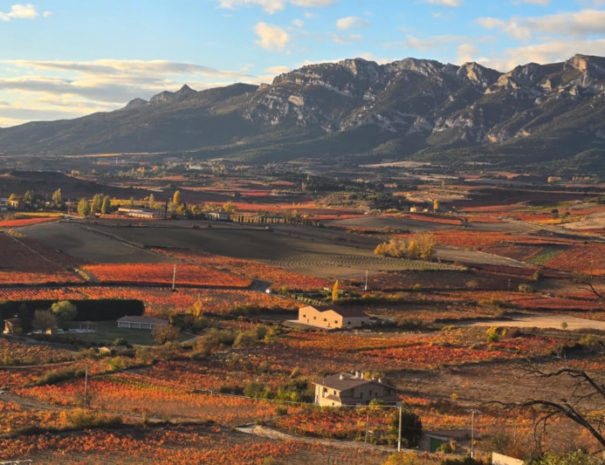
What you find at the end of it is the engine room of Spanish sparkling wine. Sant Sadurní sits on top of kilometres of cellars; Codorníu alone stores millions of bottles under the hill, in tunnels you tour on a little train. Above ground it is vineyard country under the serrated grey wall of Montserrat, on lanes quiet enough to ride all day — though rather hillier than the photographs of the Penedès let on. The two days here come to 117km and close to 1,450m of climbing — more than any other destination here.
And if your weekend happens to fall in early October, there is a real festival to walk into. Escumostra — the show everyone still calls Cavatast — takes over the streets of Sant Sadurní in early October: growers' stands, a tasting glass on a lanyard, food from the local kitchens. It was renamed and widened to take in Corpinnat and Clàssic Penedès alongside cava, which tells you something about how contested the word 'cava' has become here.
The timing works for the other reason too: the sparkling harvest happens in August, so by October the presses are washed down and the growers have time to talk.
A little history
Vines have grown here since the Phoenicians, and the Romans shipped Penedès wine from the port at Tarragona. The modern story starts with disaster: phylloxera arrived in 1887 and destroyed the vineyards, which were replanted largely to white varieties — and those varieties turned out to suit sparkling wine. Josep Raventós of Codorníu had already made the first bottle-fermented Catalan sparkling in 1872 after a study trip to Champagne, and the replanting gave the new style an entire region to grow in. The modernista architects who built Barcelona's Eixample built the cellars too. In 2019 nine of the best small growers walked out of the DO Cava altogether, exasperated by a designation that covered everything from long-aged estate wine to supermarket fizz, and founded Corpinnat: organic, hand-picked, estate-grown, minimum eighteen months on the lees. The argument is still going, and it is worth understanding before you order.
What it costs
Per person for the whole weekend, priced for a party of four — two twin rooms, or one whole place between you. Everything but the bed is fixed, so where you sleep is the only row that moves and the only one shown as a range.
| Per person | |
|---|---|
| Getting there, both ways | £106 |
| Three nights | £75–160 |
| Bikes and getting about | £66 |
| Eating, drinking and tastings | £155 |
| The weekend, per person | ~£400–490 |
Where to sleep
| Option | Per person |
|---|---|
| Hotels — two twin rooms | |
| Hostel Penedès and small hotels in Vilafranca | €28 a night £75 for three |
| Three-star hotels in Vilafranca and Sant Sadurní | €62 a night £160 for three |
| Airbnb and self-catering — one whole place | |
| The typical Vilafranca listing — only 34 of them, so book early | €43 a night £110 for three |
A thin market: 34 active listings against 1,250 in Carcassonne, and priced accordingly.
Eating and drinking
| What | Each |
|---|---|
| A menú del día — three courses with a drink | €11–16 |
| Dinner with a bottle of still Penedès | €30–50 |
| A cava house visit | €10–20 |
| A glass of cava at the bar | €3–5 |
The £155 above assumes the middle of this list: a cheap lunch, an ordinary dinner, one good one over the weekend, and wine throughout. It does not change with the room.
Day by day
Friday Arrive & the town
- Morning flight, train out through the vineyards, bags down by mid-afternoon.
- Dinner in town. If your dates have landed on Escumostra, this is its opening night: buy the glass and the strip of tickets and work along the growers' stands in the street. Otherwise the cellar-door bars on Carrer Hospital do the same job more quietly.
- This is the unpretentious end of sparkling wine — plastic tables, long queues for the good stands, families out until late.
- Dinner from the food stalls, or a table at one of the celler restaurants in town.
Saturday Over the Subirats ridge and up the Anoia
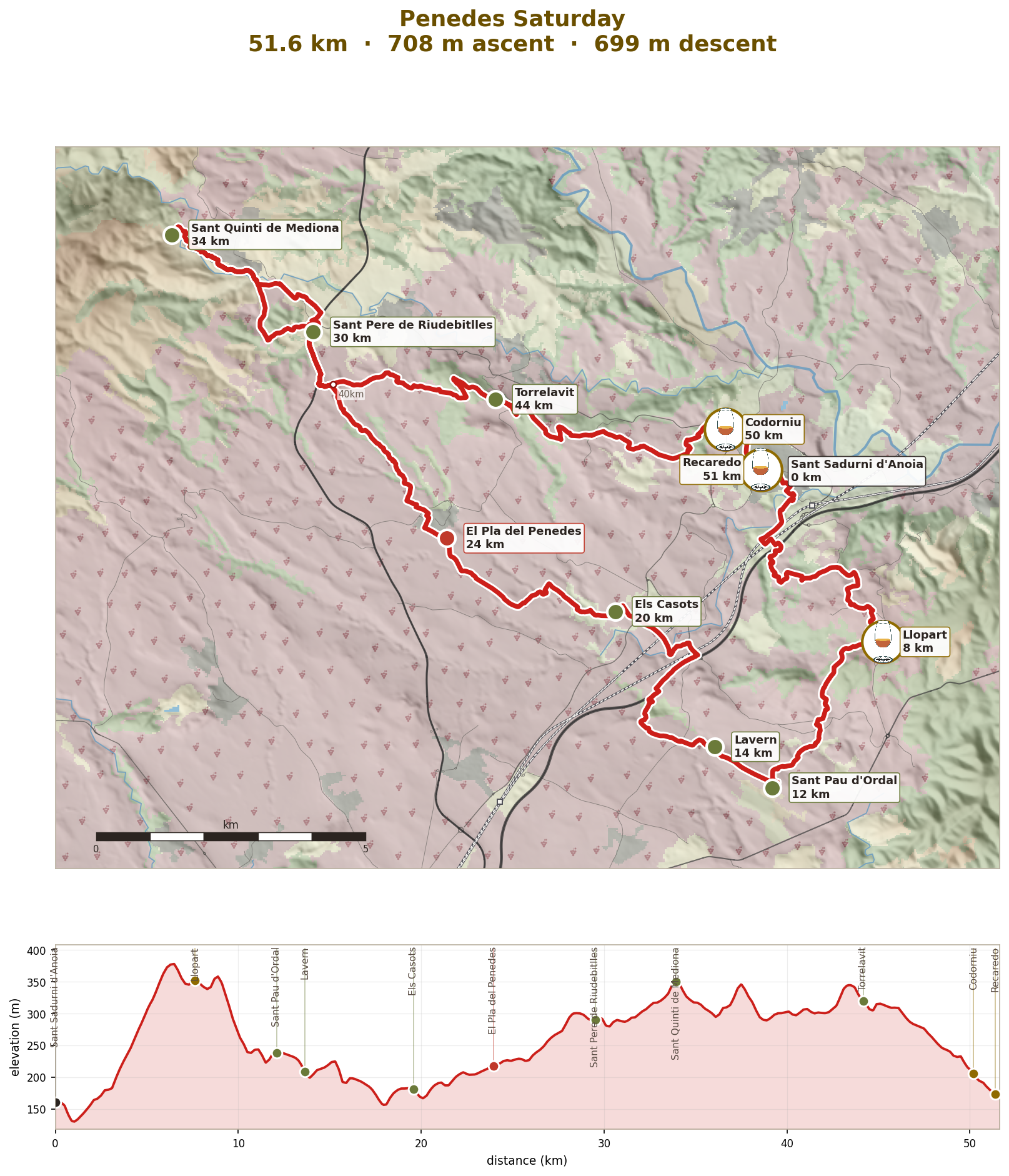
- 51.6km with 708m of ascent — considerably more climbing than the region's reputation for gentle vineyard lanes suggests, and most of it in one place.
- The climb is the first thing that happens. Out of Sant Sadurní at 130m and up to 378m by the sixth kilometre — a steady 250m haul onto the Subirats ridge before anyone has warmed up. It is also the only sustained climb of the day.
- Llopart at 8km, sitting on top of it. A family estate documented back to 1385, with Montserrat's sawtooth ridge in front of you and the Mediterranean behind. Corpinnat, and one of the easier top-tier visits to book. Spit here — there are forty-three kilometres still to ride.
- Down off the ridge through Sant Pau d'Ordal at 12km and Lavern at 14km, then along the valley floor by Els Casots at 20km.
- El Pla del Penedès at 24km is halfway and the obvious lunch. Spanish lunch starts at two and takes two hours; the second half of this ride is the hillier half, so plan accordingly.
- North-west up the Riudebitlles through Sant Pere de Riudebitlles at 30km, an old paper-mill village on the river, to the far point at Sant Quintí de Mediona, 34km and 350m — the second high point, reached gradually rather than steeply.
- Then a long, mostly downhill run back down the Anoia valley through Torrelavit at 44km.
- Codorníu at 50km and Recaredo at 51km — the two cellars, back to back, at the very end of the ride. Puig i Cadafalch's 1895 modernista cellars and their little underground train, then everything the big houses are not: estate fruit, biodynamic, hand-disgorged, aged for years. Bikes away first.
51.6 km · 709 m of ascent · 131–378 m
Sunday Sant Martí, Torres and Vilafranca
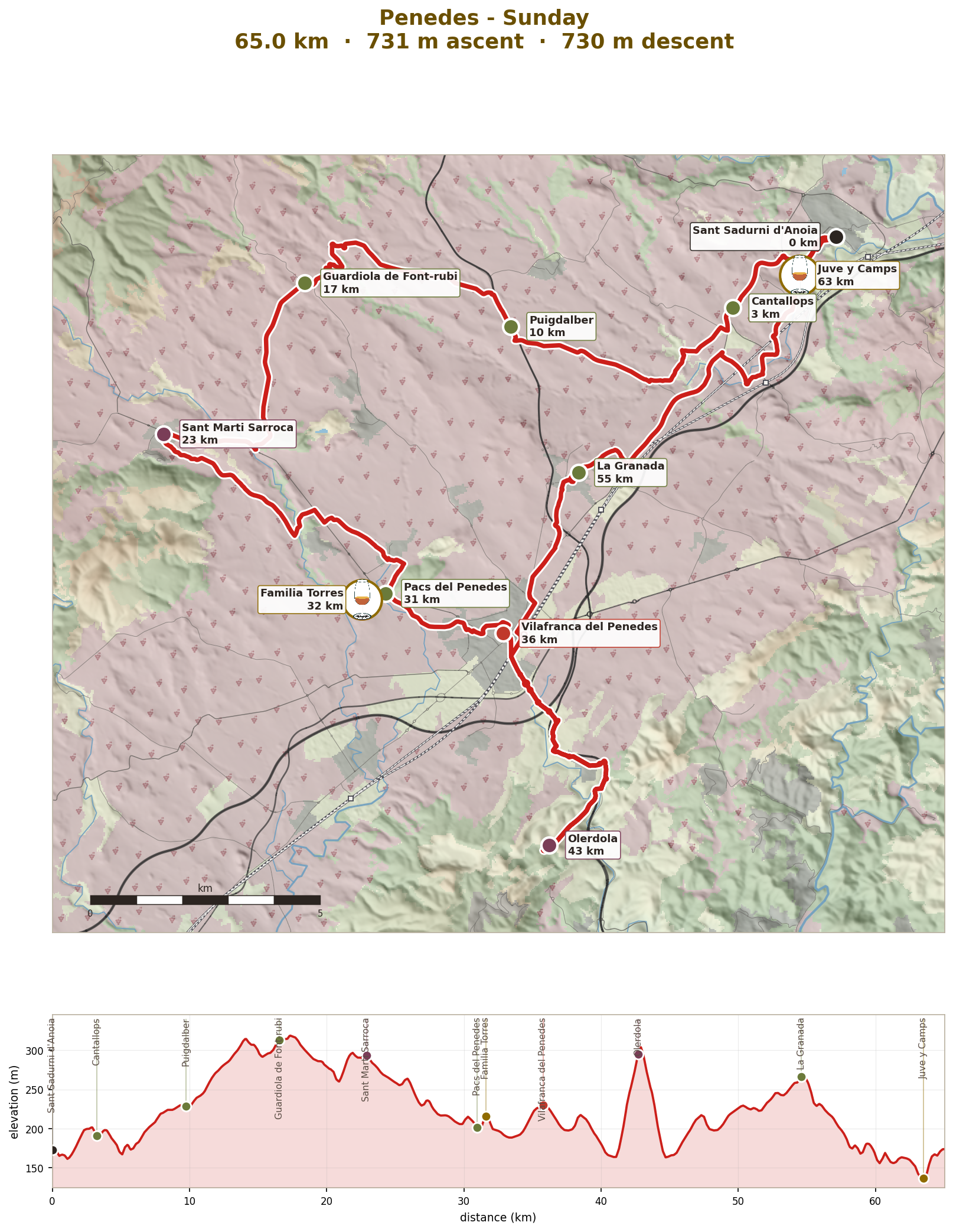
- 65.0km with 731m of ascent — the longest day of the weekend and marginally the hilliest, but it rides easier than the Saturday because the climbing is spread across the whole day rather than stacked into the first six kilometres.
- Straight out into the vines through Cantallops at 3km and Puigdalber at 10km, then a long gradual rise west.
- Guardiola de Font-rubí at 17km is the high point of the day, at a little over 310m.
- Sant Martí Sarroca at 23km: a castle and a Romanesque church sharing a crag above the village, and the best view in the Penedès. Worth locking the bikes and walking up.
- Familia Torres at 32km, just past Pacs del Penedès. A large, well-run visitor operation with its own train through the vineyard, and a genuinely interesting story underneath the scale: the family has spent decades hunting down and replanting Catalan varieties that phylloxera and fashion had wiped out. Book online.
- Vilafranca at 36km for lunch and the VINSEUM, the wine museum in the old royal palace — better than it sounds, and a good hour out of the sun. Vilafranca is also home to the best castellers in Catalonia; the great human-tower displays belong to the August festa major, but the training halls are part of the town's furniture.
- Olèrdola at 43km, and the route climbs onto the plateau rather than passing below it — 244m at the foot, 304m at the top, and the second real climb of the weekend. Iberian defensive walls, a Roman watchtower and cistern, a Romanesque church and rock-cut graves, all on one small crag: two thousand years of people fortifying the same rock. It is why the Sunday is 65km rather than 59.
- North again through La Granada at 55km, the last rise of the day, then downhill home.
- Juvé y Camps at 63km, on the edge of Sant Sadurní and the last stop before the hotel — family-owned, and the long-aged Gran Reserva is the house style.
65.0 km · 731 m of ascent · 137–317 m
Monday Barcelona, then home
- Train back in the morning and use the city: the Boqueria, the Sagrada Família, or an hour on the beach at Barceloneta.
- Airport is 25 minutes from Sants. Evening flight home.
When to go
Spring — March to May
12–22°C, warm and green, with Montserrat sharp on the horizon. Calçot season runs to about April, which is reason enough on its own. Reliable weather by northern European standards.
Summer — June to August
22–30°C, hot inland with a sea breeze in the afternoons, and Barcelona an hour away for a beach. The vineyards are worked early and the villages sleep at midday.
Autumn — September and October
14–25°C. The sparkling harvest happens in August, so by autumn the cellars are calm, the growers have time, and the first weekend of October brings the region's own festival.
When to go
Early October for the festival, or March and April for calçotades and green hills. Both beat the August heat.
Festivals
None of this weekend assumes a festival. The rides work on any weekend of the season. If your dates land on the Escumostra at Sant Sadurní in early October, the Saturday route passes through the town — finish there rather than looping back, and take the train home. The trade is worth stating plainly: on a festival weekend the growers are behind a stand in the square rather than showing visitors round a cellar, so book private tastings weeks ahead or accept that some will be shut, and expect beds to be scarcer, dearer and gone months in advance.
Spring
Calçotada season — January to April
Charred spring onions pulled from the fire, dipped in romesco and eaten with a bib, washed down with young red. A Catalan institution and a spring-only pleasure.
Sant Jordi — 23 April
Books and roses in every street in Catalonia. Not a wine festival, but a lovely day to be there.
Summer
Festa Major de Vilafranca — late August into September
The castellers of Vilafranca build human towers nine levels high in the square. There is nothing else like it.
Autumn
Escumostra (long known as Cavatast), Sant Sadurní — early October
The town's sparkling wine and gastronomy fair, now widened beyond cava to Corpinnat and Clàssic Penedès. Growers' stands in the streets and a glass on a lanyard.
Getting there
From London, per person, assuming bikes are hired locally rather than flown. Fares checked September 2026 and converted at €1 to 86p.
| Leg | Time | Cost |
|---|---|---|
| The flight | ||
| Gatwick, Heathrow, Luton or Stansted to Barcelona (BCN) — dozens a day on easyJet, BA, Vueling and Ryanair. The frequency means a missed flight is an inconvenience, not a disaster | 2h 05 | £45 |
| Airport into Barcelona | ||
| Train or Aerobús to Barcelona Sants (€5) | 0h 25 | £4 |
| Out to the Penedès | ||
| Rodalies R4 to Vilafranca, or Sant Sadurní ten minutes earlier (€5). Bikes travel free outside the weekday peak | 0h 55 | £4 |
| Waiting and one change | 0h 55 | — |
| Door to door, one way | 4h 20 | £53 |
| Both ways | £106 | |
A taxi straight from the airport to Vilafranca is €90 for the car and takes 45 minutes — worth it shared, with luggage.
Bike hire
Assumes hybrids.
| Shop | Rate |
|---|---|
| Bikemotions, at Lavern-Subirats station between Sant Sadurní and Vilafranca — you step off the train into the hire shop | €55 standard €65 e-bike |
| Penedès Ecotours — electric bikes by the full day or a full 24 hours | €35 a day |
| Vilafranca town centre — a mountain bike with helmet and spare tube can be had for the day | €20 a day |
Getting about
| What | Cost |
|---|---|
| Bike hire, Saturday and Sunday | £60 |
| Rodalies trains, allow | £6 |
| Getting about, whole weekend | £66 |
Bikes ride free on Rodalies outside the weekday peak, so the rides can start and finish in different towns.
The wineries
Codorníu
Puig i Cadafalch's 1895 cellars are a listed national monument, and the tour runs by train through kilometres of underground galleries. The most visually extraordinary winery visit on this whole list, bookable online in English.
Recaredo
Everything the big houses are not: estate fruit only, biodynamic, aged for years, every bottle disgorged by hand without freezing. Small, serious and much in demand — book several weeks ahead.
Llopart
Family estate documented back to 1385, up on a ridge with Montserrat in front of you and the Mediterranean behind. Corpinnat, and one of the easier top-tier visits to book.
Familia Torres
A large visitor operation with a vineyard train and a genuinely interesting story: the family has spent decades hunting down and replanting Catalan varieties that phylloxera and fashion had wiped out.
Juvé y Camps
Family-owned and still run that way, with a house style built on long lees-ageing — the Gran Reserva is the one to ask for. Conveniently placed on the edge of town at the end of the Sunday loop.
Freixenet
The other giant, directly opposite the railway station, with a straightforward cellar tour if you want the industrial-scale counterpoint to Recaredo.
The wines
The sparkling trio is Xarel·lo, Macabeu and Parellada — Xarel·lo the backbone, waxy and firm, and increasingly bottled on its own as a still white worth taking seriously. Long-aged Corpinnat and Cava de Paratge Qualificat are the top of the tree; ordinary supermarket cava is a different drink and the growers here will happily tell you so. There are good reds too, from Tempranillo (Ull de Llebre), Garnacha and, at Torres, Cabernet — Mas La Plana beat the first growths in a famous 1979 Paris tasting.
Eat & drink
| Friday | Dinner in Sant Sadurní — the Escumostra stands if the dates suit |
| Saturday | Long lunch at El Pla del Penedès, halfway round |
| Sunday | Vilafranca at 36km — market cooking and a bottle of still Xarel·lo |
| Monday | Barcelona — the Boqueria, or vermouth and tapas before the flight |
The food
Pa amb tomàquet with everything, botifarra and grilled vegetables, esqueixada of salt cod, arròs and fideuà on Sundays, and mel i mató to finish. The regional speciality is xató — escarole, salt cod, anchovy and a romesco-like almond sauce — though the xatonada season proper starts in November, a few weeks after us. Long lunches are the norm; plan the riding around them rather than the other way round.
Where to stay
Cal Blay / town hotels, Sant Sadurní
Small and simple, but both rides start and finish here, and during Escumostra being able to walk home matters more than thread count. Book early for the festival weekend.
Sol i Vi
Comfortable, unfussy, surrounded by vines and well placed for riding to either town.
Hotel Mastinell
A wine hotel on the edge of town, architecturally striking — the roof is built to look like stacked bottles — with its own cellar and restaurant.
Practical
- Spain allows cyclists 0.5 g/l (0.25 mg/l on the breath), and since 2025 has been testing and fining cyclists in earnest — €500 to €1,000. See the country-by-country table.
- Book Recaredo first and build the weekend around it. It is small, it sells out, and it is the visit that will stay with you.
- Escumostra means beds go early. Sant Sadurní is a small town with a big festival; if you cannot get a room there, Vilafranca is ten minutes by train.
- Cava, Corpinnat and Clàssic Penedès are three different things — and asking a grower to explain the difference is the single best conversation-opener in the region.
- Bikes travel free on the R4 outside the weekday rush, which turns any ride into a one-way ride.
- Sunday is quiet in Spain — plan the Torres visit and lunch in advance rather than turning up hopefully.
- The Saturday climb comes first, not last. Two hundred and fifty metres in the opening six kilometres, straight out of the hotel and onto the Subirats ridge. Everything after it is easier.
- Both loops start and finish in Sant Sadurní, which is why it makes the better base of the two towns — and why the cellars land at the end of each day rather than the middle.
- Lunch is late and long. Nobody eats before two, and no cellar will be pleased to see you at three.
- Penedès Turisme — the official regional tourist board — cellars, events, routes
- Escumostra / Cavatast — the town hall page for the festival, with dates, tickets and programme
- Corpinnat — the breakaway growers' association — who they are and why they left
- DO Penedès — the appellation: varieties, producers and the still wines
- Rodalies de Catalunya — line R4 timetables from Barcelona Sants to Sant Sadurní and Vilafranca