Overview
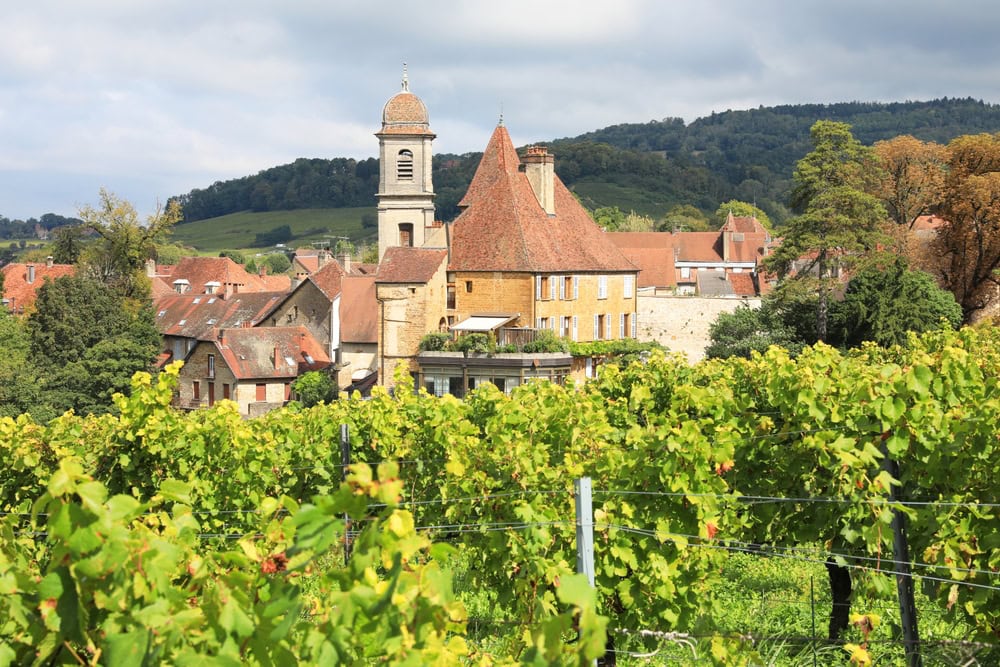
Four days in Arbois, a small town of arcaded streets and a river, sitting where the plain of the Saône runs into the first step of the Jura. It is the capital of a wine region of about six thousand hectares — against Bordeaux's hundred thousand — which makes it one of the smallest serious vineyards in France and, by some distance, the strangest.
The reason to come is vin jaune: Savagnin left in barrel for six years and three months without topping up, so a veil of yeast forms on the surface and the wine oxidises under it into something between fino sherry and nothing else on earth. It is bottled in the 62cl clavelin, the only bottle size in the EU with its own legal exemption, sized to hold what a litre of wine becomes after six years of evaporation. Alongside it there is Poulsard so pale it barely counts as red, Trousseau, Chardonnay that tastes nothing like Burgundy's, and vin de paille made from grapes dried on straw.
The riding is the other half of the case. The vines sit on the plain edge; directly behind them the limestone plateau is cut open by reculées — blind valleys that run inland between vertical cliffs and simply stop. Riding into one is a genuinely odd experience, and there are two great ones within a day of the town.
Getting There
| Outbound | Eurostar, St Pancras to Paris Gare du Nord, about 2h20. Several a day; cheapest booked months ahead |
| Across Paris | Gare du Nord to Gare de Lyon — one RER or two métro stops, about 15 minutes. Simpler than the Chablis transfer |
| Onward | Paris Gare de Lyon to Mouchard by TGV, about 2h20. Mouchard is the junction for the whole wine region |
| Last 10km | Mouchard to Arbois is a short TER hop or a ten-minute bus — or hire the bikes at Mouchard and ride it, which is the better answer |
| Door to door | About six and a half hours, all of it on trains |
| If you would rather fly | Geneva is the nearest useful airport, about two hours away by road but awkward by rail. Flying does not save time here, and the train is the point |
Day by Day
Friday Arrive & Pasteur
- Morning Eurostar, into Arbois by late afternoon. Check in and collect bikes — A Tour de Roues is a café-vélo in the station building itself and hires gravel bikes and e-bikes, with free delivery within 10km.
- The Maison de Louis Pasteur, the family home and his own laboratory, kept as he left it. He grew up here and came back every summer, and it was Arbois wine he was working on when he worked out what fermentation actually is. There is no better place to start a wine weekend.
- Dinner at Le Bistrot des Claquets on rue de Faramand — seasonal cooking and a natural wine list that leans hard on the Jura. The grander option is Maison Jeunet on the rue de l'Hôtel de Ville, the town's serious kitchen for forty years.
Saturday Train south, over the plateau, and down the cliff into Baume
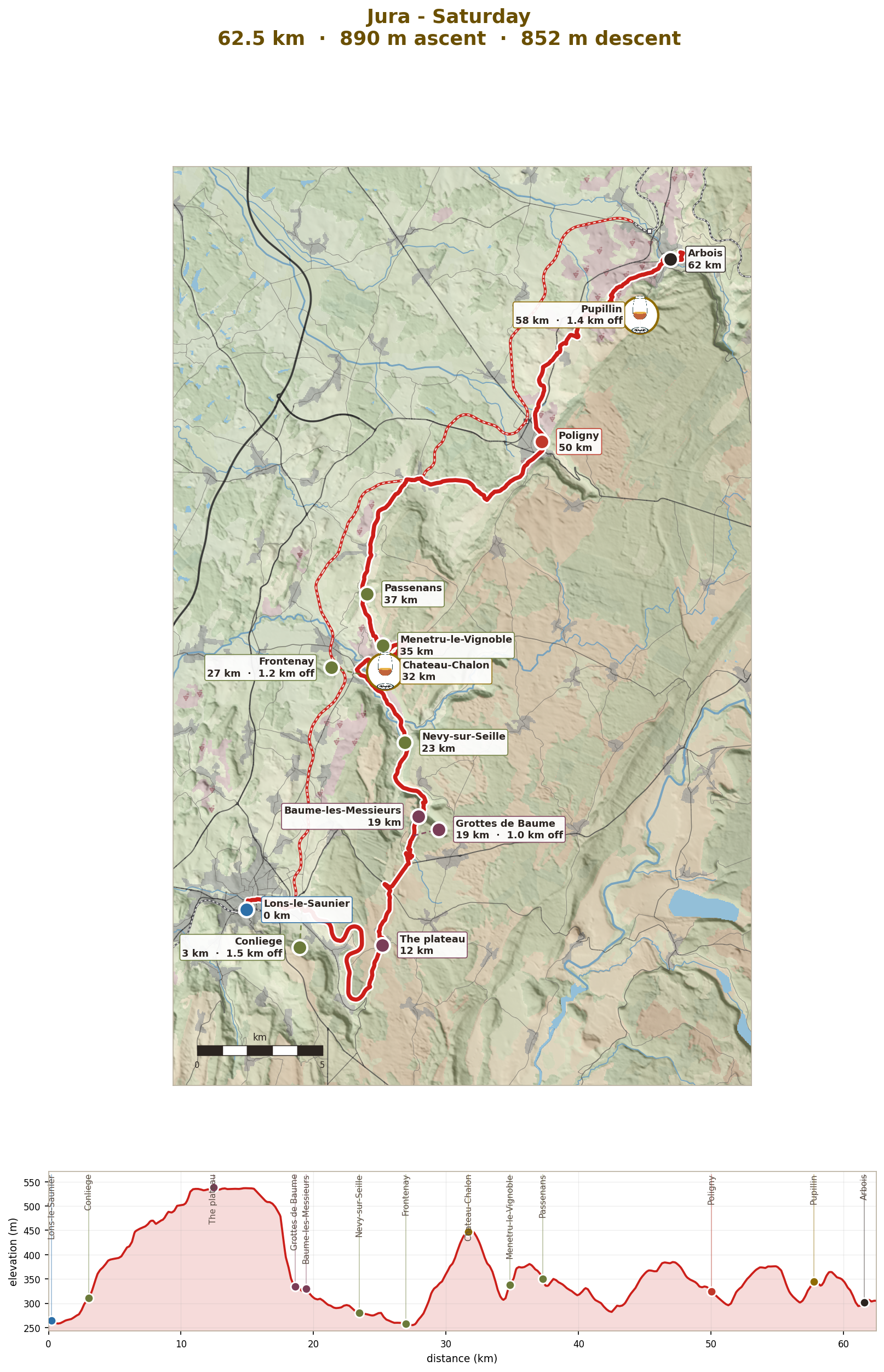
- 62.5km with 890m of ascent — one way, from Lons-le-Saunier back to Arbois, with the train doing the outward leg. It is the hardest single day on this site, ahead of the Champagne Sunday's 832m and over twenty kilometres shorter. Take that seriously or take the e-bike.
- The train first. Arbois to Lons-le-Saunier is about 25 minutes on the same TER line you arrived on, through Poligny and Domblans-Voiteur. Lons is a spa town with an arcaded main street and a claim on the Marseillaise — Rouget de Lisle was born there.
- Then straight up, before coffee. The road climbs 212m in the first eight kilometres at a steady 3%, past Conliège at the mouth of the Reculée de Vaux, onto the plateau. It tops out at 539m by 12km and then rolls along the top for four more.
- Down the cliff into Baume-les-Messieurs at 19km, and this is what the climb bought. Instead of riding up the valley floor and looking at the walls from below, you come over the lip and descend into the reculée — 537m to 311m, with one pitch dropping from 478m in about five hundred metres. At the bottom, a Benedictine abbey with a 16th-century Antwerp altarpiece, and one of the plus beaux villages de France.
- The caves are a kilometre up at the head of the valley: 600 metres of galleries, chambers to 80 metres, an underground river. April to September, and the tour is 55 minutes — with 43km and two climbs still ahead, that is a decision rather than a detour.
- Château-Chalon at 32km, up 192m in 4.2km at 4.5% from the valley floor at Frontenay. Fifty hectares — the smallest appellation in France — on a clifftop above its own vines, and the only place on earth where vin jaune is the only wine permitted. Domaine Macle is the name everyone knows; arrange it weeks ahead. The Fruitière de Voiteur, two kilometres west at the foot of the climb, is the fallback and not a poor one.
- North through the vineyard villages — Ménétru-le-Vignoble, Passenans, Saint-Lothain — rolling rather than climbing, three rises of seventy or eighty metres apiece. Poligny at 50km is lunch, under its own cliff: capital of Comté rather than of wine, and the Maison du Comté deserves as much attention as any cellar.
- Pupillin at 58km, a kilometre and a half off the road and worth the climb: the village calls itself the world capital of Ploussard and has its own named appellation. Then four kilometres down into Arbois.
- Finish at the Fruitière Vinicole d'Arbois, in town at Château Béthanie — founded by 31 growers in 1906 and the oldest wine co-operative in France. Tours and tastings by appointment year-round, walk-ins in July and August, and the one tasting of the weekend you can rely on booking.
Sunday The salt road to Salins-les-Bains
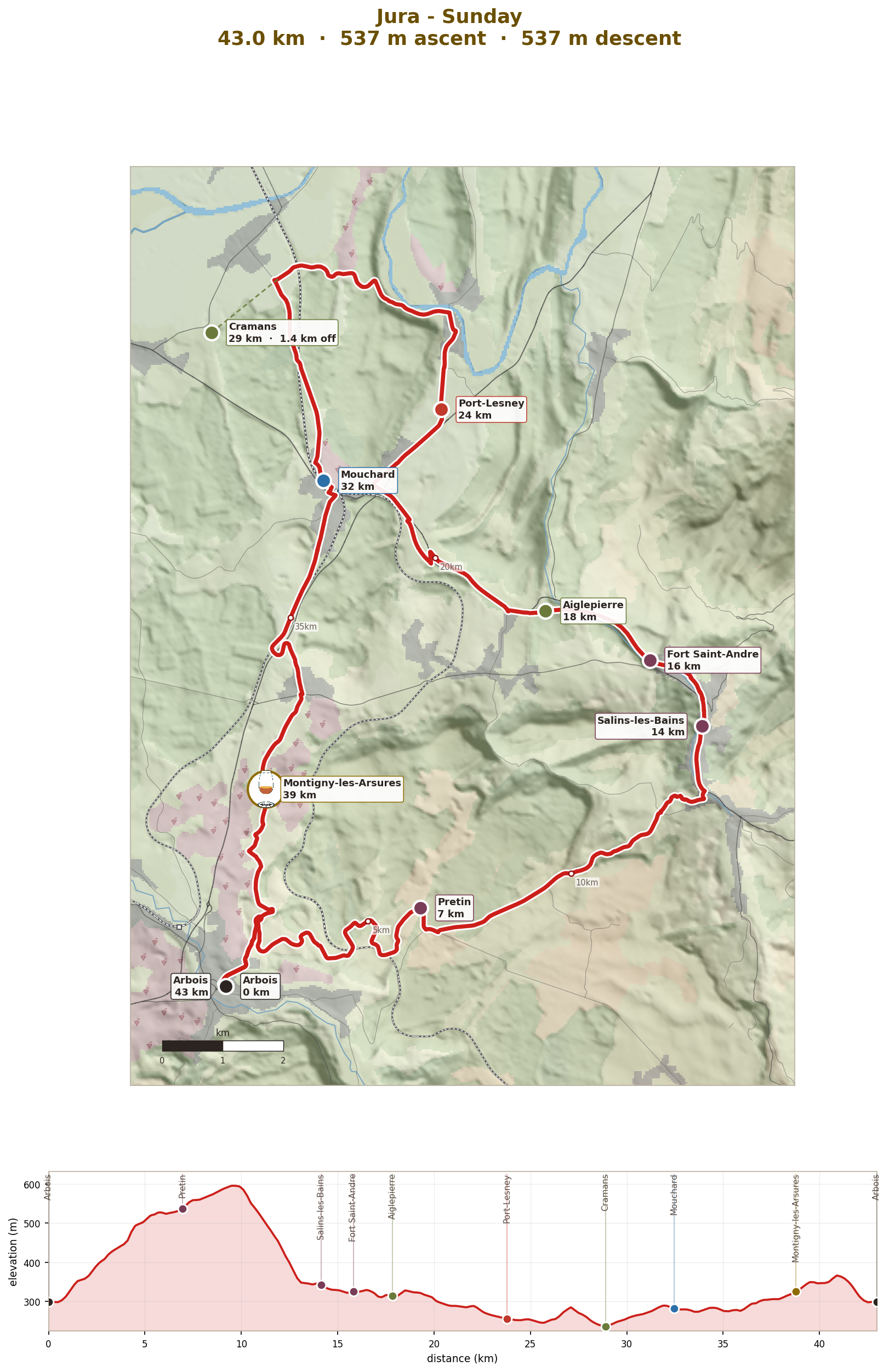
- 43.0km with 537m of ascent, north and east out of Arbois over the plateau and back down the Loue. Shorter than the signposted 72km version, and all the climbing is in the first ten kilometres.
- Straight up, first thing. The road climbs from 300m in Arbois to nearly 600m on the plateau by 10km — Prétin at 7km is most of the way up. It is the only sustained climb of the weekend and it is done before nine.
- Salins-les-Bains at 14km, and the strangest thing on the weekend. The Grande Saline has been UNESCO-listed since 2009, together with the Royal Saltworks at Arc-et-Senans: an 11th-century underground gallery 165 metres long, a pump still lifting brine at 330 grams of salt per litre — saltier than the Dead Sea — and 1,200 years of industrial history under a spa town. Guided tour only, about an hour.
- Port-Lesney on the Loue at 24km, and the lowest ground of the day at about 240m — a river the colour of bottle glass, with beech woods most of the way. Mouchard at 32km is the junction you leave from on Monday.
- Montigny-lès-Arsures at 39km is the Trousseau village — a grape grown almost nowhere else in France, and several of the best growers in the appellation on one road, four kilometres short of home. If Château-Chalon did not work out, finish at Domaine Rolet in Arbois: family-run since 1942, and the full range of Jura styles in one visit.
Monday Home
- The market in Arbois if the day allows, then the short hop to Mouchard and the TGV to Paris.
- Buy the vin jaune here rather than at home. The clavelin does not travel through many UK shops, and the price difference is not small.
Festivals & Local Events
None of this weekend assumes a festival. The rides work on any weekend of the season. If your dates land on the Fête du Biou on the first Sunday of September, it happens in Arbois itself and the base is in the middle of it — ride in the morning and be back for the procession. The Percée du Vin Jaune in February is the region’s great day but falls well outside cycling season; it is a reason for a different sort of trip. The trade is worth stating plainly: on a festival weekend the growers are behind a stand in the square rather than showing visitors round a cellar, so book private tastings weeks ahead or accept that some will be shut, and expect beds to be scarcer, dearer and gone months in advance.
Winter
Percée du Vin Jaune — first weekend of February
The new vintage broached after six years and three months, with a ceremonial first barrel opened in front of a crowd. It moves village to village each year: 6 and 7 February 2027, at Arlay. Thousands of people, a tasting glass, and cellars open the length of the village. Nobody is going to cycle to it, but it is the region's great day.
Spring and summer
Festival de la Randonnée — spring
Guided themed walks run by the tourist office, including oenovélo rides and tastings out in the vineyards. A good way to get inside cellars that do not otherwise open.
Village fêtes and open cellars — summer weekends
Small, local and unadvertised outside the region. Ask at the Fruitière or the tourist office when you arrive rather than trying to plan around them.
Autumn
Fête du Biou, Arbois — first Sunday of September
The one to know about. A biou is an enormous bunch of grapes assembled from many smaller ones, carried through the town on a frame by the growers in procession and offered in the church. The tradition is first recorded in the 17th century and it is still entirely a working town's festival rather than a tourist one. It falls squarely in cycling season, which the February event does not.
The Region in Brief
A little history
The Jura vineyard covered some 20,000 hectares in the 19th century and phylloxera took almost all of it; what came back is about 6,000. Arbois was the first appellation granted in France in 1936, and the Fruitière Vinicole — founded in 1906 by 31 growers facing phylloxera and cheap wine from the south — did much of the work to get it. Louis Pasteur's fermentation studies were carried out on this wine, in a vineyard he owned outside the town.
Spring — April and May
5–18°C and unreliable. The vines come late here and so does the warmth; April can be beautiful or it can rain for four days.
Summer — June to August
13–27°C, long light, green plateau, and the best of the riding. Warm without being oppressive — the altitude and the forest see to that.
Autumn — September and October
7–20°C, harvest, and the Biou on the first Sunday of September. October turns quickly and the mornings are cold.
When to go
June or the first week of September. June for the light and the green; September for the harvest, the Biou and warm afternoons. Be blunt with yourself about the rest of the year — this is the wettest and coldest region on the site, and November to March is not a cycling proposition.
The wines
Five grapes and rather more styles. Savagnin for vin jaune and for oxidative whites; Chardonnay, often blended with it; Poulsard, so pale it looks like rosé and tastes like neither; Trousseau, darker and more structured, essentially a Jura speciality; Pinot Noir. Plus vin de paille from grapes dried on straw, and Macvin, a fortified mistelle. Nothing here tastes like the wine of anywhere else, which is the entire point.
The food
Comté above all — Poligny is its capital and the difference between an 8-month and a 24-month wheel is worth the trip on its own. Then Morbier with its ash line, Mont d'Or in the winter months, saucisse de Morteau, and poulet au vin jaune et aux morilles, which is one of the great regional dishes of France and tastes of the wine it is named after.
Where to Stay
Maison Jeunet
The town's grand address, hotel and restaurant together, and the kitchen that made Arbois a place people travelled to eat. The comfortable choice.
Small hotels and châmbres d'hôtes in Arbois
Arbois is small and the bed count is low. Book early, particularly for the first weekend of September, when the Biou fills the town.
Poligny or Salins-les-Bains
Both are on the route and both have more rooms than Arbois. Salins is a spa town, which is a pleasant thing to have at the end of a hilly day.
The Wineries
Fruitière Vinicole d'Arbois — Château Béthanie
Founded by 31 growers on 4 January 1906 and the oldest wine co-operative in France. It covers every Jura style in one visit, including vin jaune and vin de paille, and it is the one tasting here you can rely on being able to book. Start with this and treat the rest as bonuses.
Domaine Rolet
One of the larger independent estates, across all five grapes and all the styles, with a tasting room in the town itself. The sensible second stop.
Domaine Macle
The reference point for vin jaune, in the village that is the appellation. Small, in demand, and not a drop-in. Write early or drink it somewhere else.
Domaine de Montbourgeau
L'Étoile is a tiny appellation south of Château-Chalon named for the star-shaped fossil crinoids in its soil. Montbourgeau is its best-known grower.
The Trousseau growers of Montigny
One village road with several of the appellation's most sought-after names on it. Most work by appointment and some have waiting lists; the tourist office in Arbois knows who is open on any given week, which is more useful than a list written months earlier.
Eat & Drink
| Friday | Le Bistrot des Claquets — natural Jura wines by the glass |
| Saturday | Comté and bread in Poligny; dinner at Maison Jeunet |
| Sunday | Lunch in Salins-les-Bains; poulet au vin jaune et morilles to finish |
| Monday | Market cheese for the train |
Useful Links
- Cœur du Jura Tourisme — the tourist office for Arbois, Poligny and Salins: events, cellars, accommodation
- Percée du Vin Jaune — the February festival, its host village and programme
- Fruitière Vinicole d'Arbois — the co-operative, its history and visiting arrangements
- La Grande Saline, Salins-les-Bains — the UNESCO saltworks, tours and opening times
- Baume-les-Messieurs — the abbey, the reculée and the caves
- A Tour de Roues, Arbois — bike hire in the station building, gravel and electric
Practical Notes
- France allows cyclists 0.5‰, the same limit as drivers — so one glass with lunch is the practical ceiling if you are riding afterwards. See the country-by-country table. Worth noting twice here: vin jaune is around 15%.
- This is the third destination on the site that needs no aeroplane. Eurostar, one métro hop across Paris, a TGV to Mouchard and ten kilometres at the end. Book the Eurostar early.
- Hire the bikes at the station. A Tour de Roues is in the Arbois station building and will deliver within 10km, which includes Mouchard — so the last leg of the journey in can be the first ride of the weekend. It also means Saturday morning starts on the right platform.
- This is a hilly weekend, and the Saturday is the hardest day on the site. 890m out of 62.5km, with 212m of it in the first eight kilometres straight off the train and the Château-Chalon climb at 32km. The Sunday is gentler at 537m over 43km, and puts nearly all of it in the first ten. E-bikes are a reasonable choice here, and A Tour de Roues hires them.
- Book Château-Chalon weeks ahead or not at all. Fifty hectares supports very few growers and none of them run a visitor operation. The Fruitière in Arbois is the reliable alternative and is not a consolation prize.
- The caves at Baume close for the winter — April to September only — and the tour takes the best part of an hour. Decide before you set off whether the day includes it.
- Two days is the right length. Six thousand hectares does not support a third day, and the page would be lying if it pretended otherwise.
- Both days use the same railway, in opposite directions: out to Lons-le-Saunier on the Saturday, and Mouchard on the Sunday route is where the TGV leaves from on Monday. Bikes go on TER without a supplement.
- Dress for the Jura, not for France. It is higher, wetter and colder than anywhere else here, and a September morning in Arbois can start at 7°C.
- Check sunset before you plan the last leg. Any day that finishes with a ride home wants an hour of light in hand, and that hour disappears fast either side of the equinoxes.